You ask ChatGPT to draft an article, replace a product photo's background with AI, or let a chatbot answer customer questions.
Does AI content labeling under the EU AI Act apply to all of that from August 2, 2026?
Short answer?
No.
The EU AI Act does not impose a blanket labeling duty on every piece of content that involves AI. It distinguishes between AI system providers, professional deployers, deepfakes, editorially reviewed text, and standard editing tools.
In this guide, I show you which cases actually matter for coaches, creators, online businesses, and agencies, and how to prepare your content workflow.
- Article 50 of the EU AI Act generally applies from August 2, 2026. It does not require a visible label for every piece of AI content.
- Professional deployers primarily have to disclose deepfakes and unreviewed AI text about matters of public interest. Providers of generative AI systems also have to make their outputs machine-readable and detectable.
- Chatbots must disclose their AI nature at the beginning of the interaction unless it is obvious. YouTube, TikTok, Meta, and other platforms have separate rules that can go further.
1. Not every piece of AI content needs a label
This is the most common misconception. Many summaries reduce the EU AI Act to a claim that all AI content must be labeled from August 2026.
The regulation does not say that.
The duties in Article 50 cover four different situations.

The AI Act calls a professional user a "deployer." A deployer can be a company, agency, freelancer, or creator using an AI system under its own authority. Purely personal, nonprofessional use falls outside these deployer duties.
Other laws and platform policies can still apply. A private TikTok post can therefore need a platform label even when its creator is not a deployer under the EU AI Act.
If you need the wider legal framework first, my complete EU AI Act guide explains roles, risk categories, deadlines, and penalties.
2. Which content you have to label as a creator
2.1 AI-generated images, audio, and video
A professional deployer must visibly disclose image, audio, or video content under Article 50(4) when it is a deepfake.
The legal definition is narrower than the word's everyday meaning. A deepfake resembles an existing or plausible person, object, place, entity, or event and could falsely appear authentic or truthful.
In practice, this leads to four useful distinctions.
- An AI video that makes a real person appear to say something they never said needs a visible disclosure.
- A realistic AI image that depicts a supposedly real event needs a visible disclosure.
- An obviously fantastical image without deceptive potential is not automatically a deepfake.
- A regular white balance correction or minor noise reduction does not become a deepfake merely because the software uses AI.
Artistic, creative, satirical, and fictional deepfakes are not completely exempt. Their disclosure may be presented in a way that does not hamper the display or enjoyment of the work.
My deepfake statistics explain the wider risks, including fraud, detection, and regulation.
2.2 AI-generated text
Three conditions must apply at the same time. The text must be published, inform the public, and concern a matter of public interest.
The Commission's guidelines include politics, public health, fundamental rights, consumer safety, and economic, financial, scientific, or cultural developments that are subject to public debate.
An AI-generated product description or a regular sales page is therefore not automatically covered by this text duty. An unreviewed AI article about an election, a public health threat, or a financial issue can be covered.
There is one important exception.
You do not need the AI disclosure when a natural person has substantively reviewed the text or a responsible editorial team has controlled it and a person or company assumes editorial responsibility for publication.
Spellchecking, a quick plausibility check, or an automated rewrite with a second AI tool does not qualify. At minimum, a qualified natural person must deliberately review the substance and fact-check its accuracy. Editorial control also requires authority to approve, alter, or reject the text on substantive grounds. That includes checking facts and the trustworthiness of sources.
If an AI system substantively modifies, supplements, or reformulates the text after the human review or editorial control, the earlier approval does not automatically carry over. The resulting version needs another qualified substantive review or editorial control if you want to rely on the exception.
2.3 Chatbots and AI agents in customer communication
A chatbot, AI agent, or avatar must tell people that they are interacting with an AI system at the beginning of the first direct exchange. The notice can be omitted only when the AI nature is obvious to a reasonably well-informed and attentive person in that context.
The duty first applies to the provider that develops the system or has it developed and places it on the market under its name. You may take on that role when you build a bot yourself, commission one under your brand, or substantially modify a system into your own product.
Even if you only embed a third-party chat widget, check whether the disclosure is visible, understandable, and accessible on your website. A sentence buried in your privacy policy appears too late for the first interaction.
2.4 Minor edits and assistive functions
A provider does not have to apply machine-readable marking when an AI system merely performs a standard editing function or does not substantially alter the input data or its meaning.
The final Commission guidelines help draw the line. Simple color correction, noise reduction, formatting, or transcription can fall within the exception. A face swap, fabricated scene, or newly invented statement does not.
Do not confuse this provider exception with a deployer's visible deepfake disclosure. If the result qualifies as a deepfake, the deployer duty remains.
The final guidelines also describe a narrow exemption for industrial AI applications and B2B applications. It applies only to the provider's machine-readable marking duty under Article 50(2). All of the following conditions must be met.
- The output is strictly technical in nature.
- It is intended for a limited, predefined number of people acting in a professional capacity within the provider's and deployer's organizations.
- It is not intended to be shared outside the company or used by external people, and safeguards prevent reasonably foreseeable misuse.
Outputs used only as intermediate steps in closed-loop industrial and product development workflows also fall outside the marking duty. This does not cover the final AI-generated or manipulated text, audio, image, or video output. Neither limitation is a blanket B2B exemption, and neither removes a deployer's visible disclosure duty.
3. When do the rules apply?
The EU AI Act entered into force on August 1, 2024. The transparency duties in Article 50 generally apply from August 2, 2026.
The December grace period comes from the 2026 AI Omnibus. It applies only to providers of generative AI systems placed on the market before August 2, 2026, and only to the technical marking duty in Article 50(2).
It does not postpone deployer duties. Deepfakes and covered text made available from August 2, 2026, must be correctly disclosed from that date. Content created and made available earlier does not require a retroactive label under the final Commission guidelines.
4. What a compliant AI disclosure can look like
Article 50(5) requires the information to be clear, distinguishable, and accessible no later than the first interaction or exposure.
That creates a few practical rules.
- A notice for an image should appear on or directly next to the image.
- A video label should appear when playback starts, not only in the closing credits.
- Audio may require a clearly understandable spoken notice.
- A notice for covered text should appear before or directly next to the text.
- A chatbot should disclose its AI nature before or in its first message.
Plain language such as "AI-generated," "created with AI," or "image and voice altered with AI" is more useful than a technical acronym.
In 2026, the EU published three optional icon types. The set contains a basic icon, a fully AI-generated icon, and a partially AI-modified icon. Each comes in black, white, and 50% transparent versions of both colors.
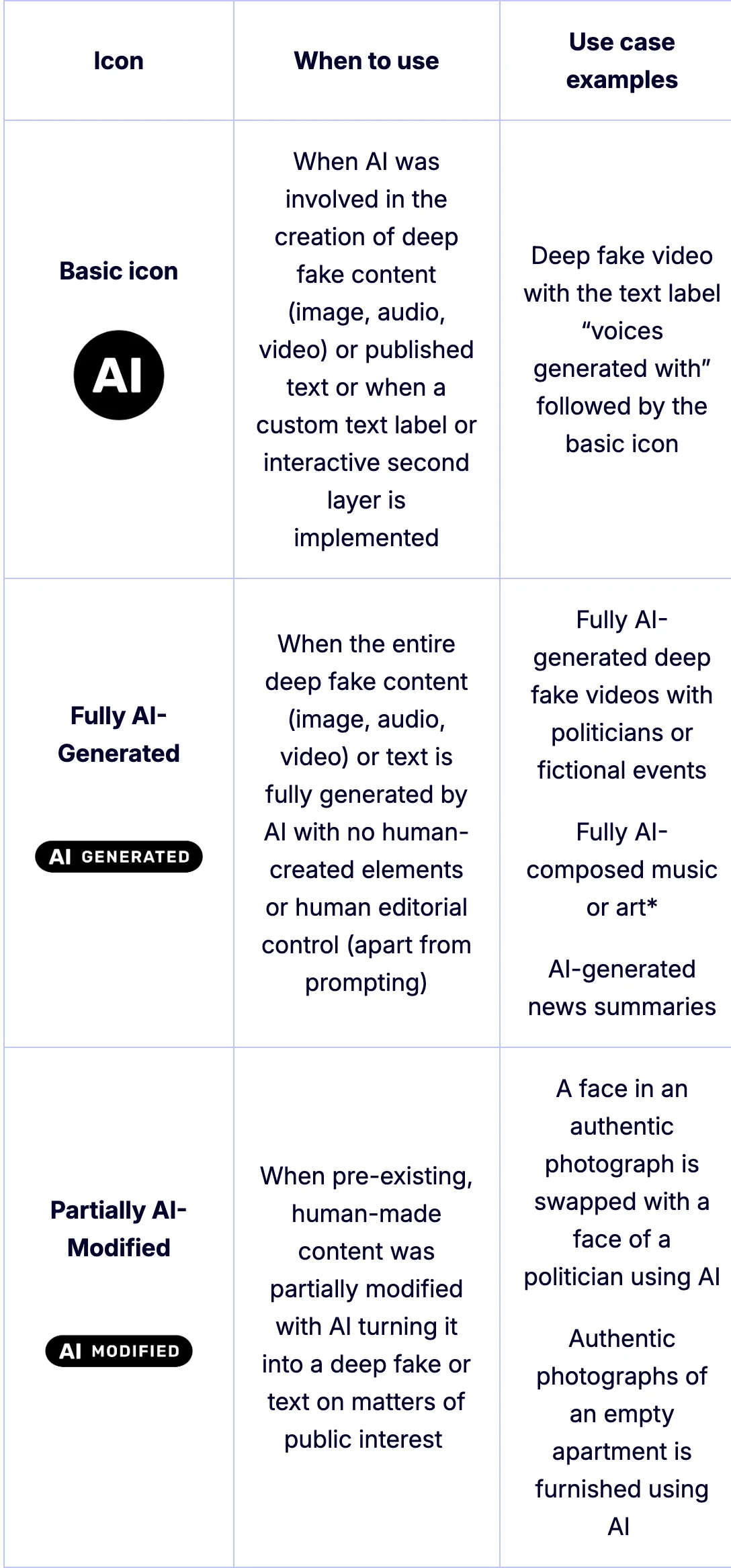
The icons are free to use and voluntary. An icon does not prove compliance on its own. The EU guidance says the icon should be clearly visible at first exposure and preferably combined with a plain-language notice.
And no.
Content Credentials, watermarks, or other machine-readable metadata alone do not fulfill a deployer's visible deepfake disclosure. They have a different job. People should be able to understand the notice without specialist software.
My technical guide to C2PA and Content Credentials explains how those signed provenance records work.
The final EU Code of Practice
On June 10, 2026, the European Commission published the voluntary Code of Practice on marking and labelling AI-generated content. The Commission and the AI Board consider it an adequate way to comply with Article 50(2), (4), and (5).
Signing is voluntary. Signatories can rely on the Code when implementing those duties. The Commission expressly says that adherence is not conclusive evidence of compliance. Non-signatories may use other adequate measures, but they must be able to demonstrate why their alternative is sufficient.
5. How to adapt your content workflow
I would not put an enormous AI stamp on every post just in case. That creates more confusion than transparency.
A defined review process works better.
- Record where AI interacts with people or generates and alters published content in your business.
- Separate ordinary AI content from deepfakes, public-interest text, and standard editing.
- Set up substantive human review and documented editorial responsibility for relevant text.
- Use visible notices and the disclosure controls provided by each publishing platform.
- Keep original files, approvals, sources, prompts, and available Content Credentials in a traceable record.
- Review the process regularly because platform policies and technical standards continue to change.
This also fits my general approach to AI. Introduce it gradually. A traceable process with human control is more reliable than a blanket label on everything.
You can turn this process into an internal rule with my copyable AI policy template for businesses.
6. What to include in contracts with external providers
Hiring an agency or freelancer does not automatically remove your responsibility. According to the Commission guidelines, a legal entity remains the deployer when contractors participate in the use of the AI system under its authority and control.
Your contract or brief should cover at least six points.
- State which AI systems may be used and which uses require prior approval.
- Require the contractor to disclose AI-generated or substantially AI-altered elements.
- Assign responsibility for substantive review, editorial approval, and labeling.
- Prohibit the removal of available provenance metadata and Content Credentials.
- Require compliance with consent, personality rights, copyright, and platform policies.
- Define which original files, sources, and records must accompany the final delivery.
A contract cannot simply transfer statutory responsibility to someone else. It can make sure you receive the information and evidence needed for a compliant publication.
7. Rules on major online platforms
The EU AI Act and platform policies apply alongside one another. YouTube or TikTok can therefore require a label even when Article 50 would not.
7.1 YouTube
YouTube requires disclosure when realistic content has been meaningfully altered or synthetically generated. Examples include a fabricated realistic event, manipulated footage of a real place, or words falsely attributed to a real person.
Minor aesthetic edits, captions, idea generation, or AI assistance with an outline or script do not require disclosure under YouTube's current help page.
Since May 2026, the label appears directly on Shorts and below the player on long-form videos. Creators answer an AI-use question during upload.
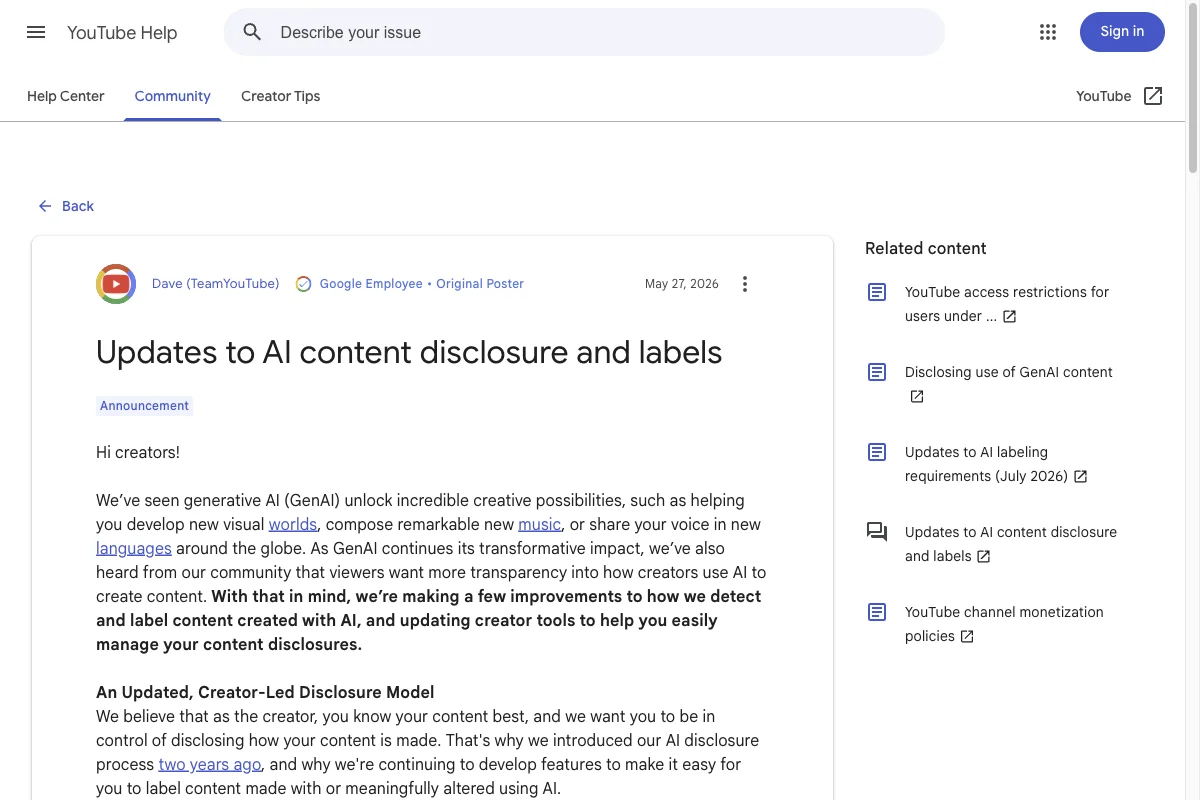
YouTube says a label by itself does not limit recommendations or monetization. Repeated failure to disclose can lead to a permanent label, content removal, or suspension from the YouTube Partner Program.
7.2 Meta with Facebook, Instagram, and Threads
Under Meta's official labeling policy, the "AI info" label can appear when technical signals indicate that content was generated with AI or a person discloses the AI use. For content that has only received minor AI edits, the information can appear in the post menu instead of directly on the post.
Meta now also detects ads created or significantly altered with third-party AI tools. When the company finds the relevant signals, the notice appears in "About this ad."
For the publishing workflow, automatic labels, and correction options, use my dedicated Instagram AI label guide.
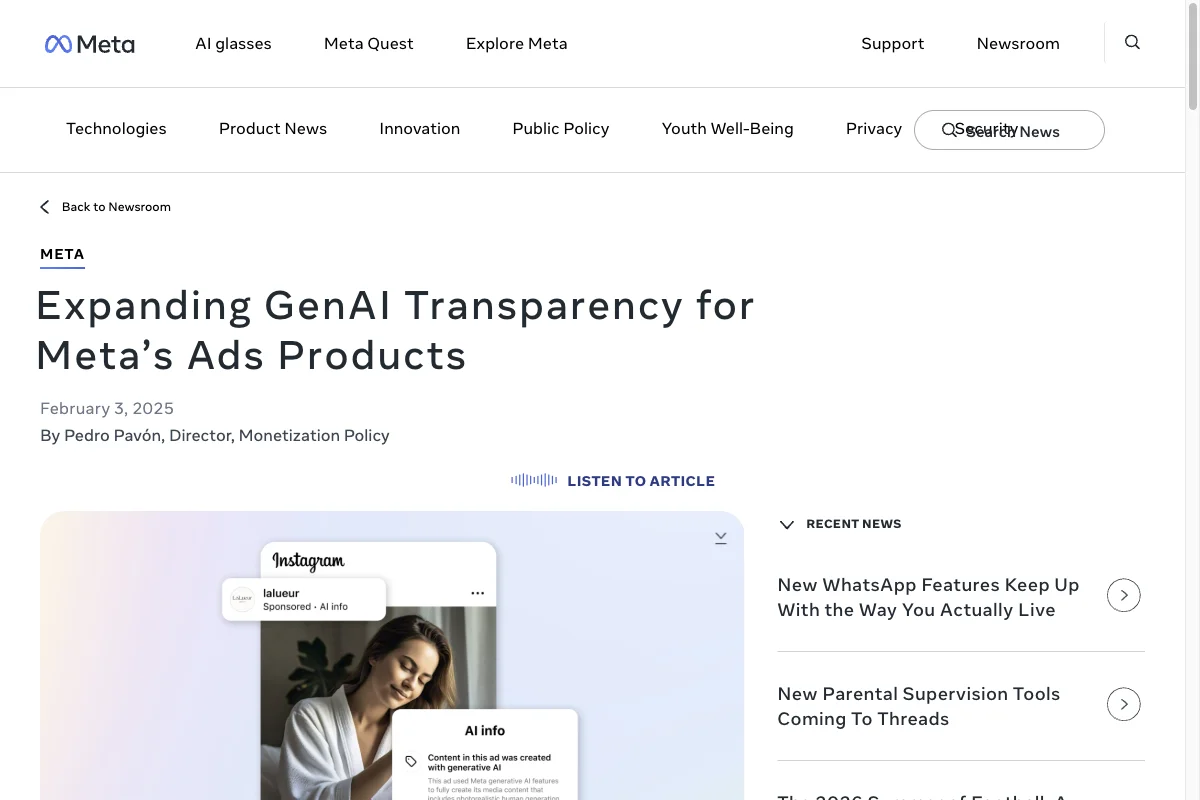
Meta explains the current approach in its official announcement about generative AI transparency in ads.
7.3 TikTok
TikTok requires a label for realistic AI-generated images, audio, and video. Creators should also label content that has been completely generated or significantly edited with AI.
You can activate the AI-generated content setting before publishing. TikTok can also apply a label automatically when you use its AI effects or upload a file with matching C2PA Content Credentials.
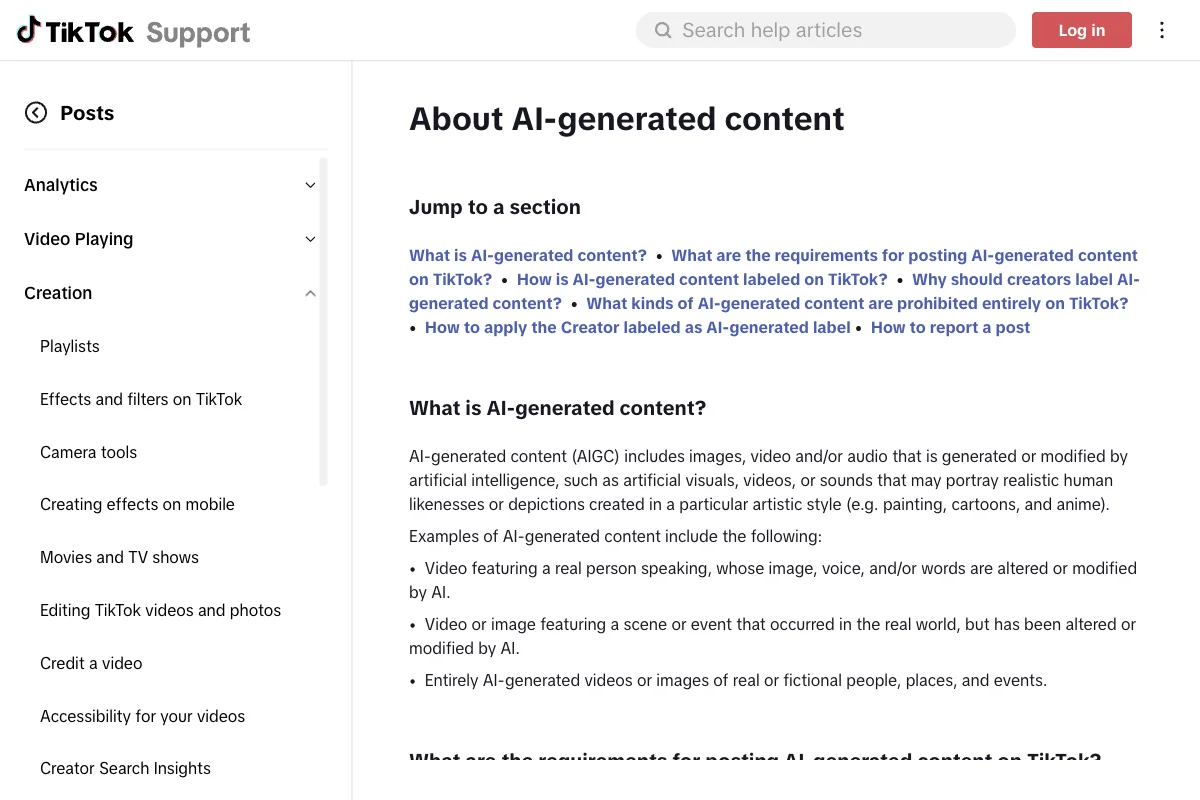
A correct label does not affect distribution according to TikTok's help page. Deceptive or abusive content can remain prohibited even when it carries a label.
7.4 LinkedIn
LinkedIn reads C2PA Content Credentials from images and videos. When a file contains this cryptographically signed provenance information, LinkedIn displays a C2PA icon. Selecting it opens details about the tool, creation process, and signature.
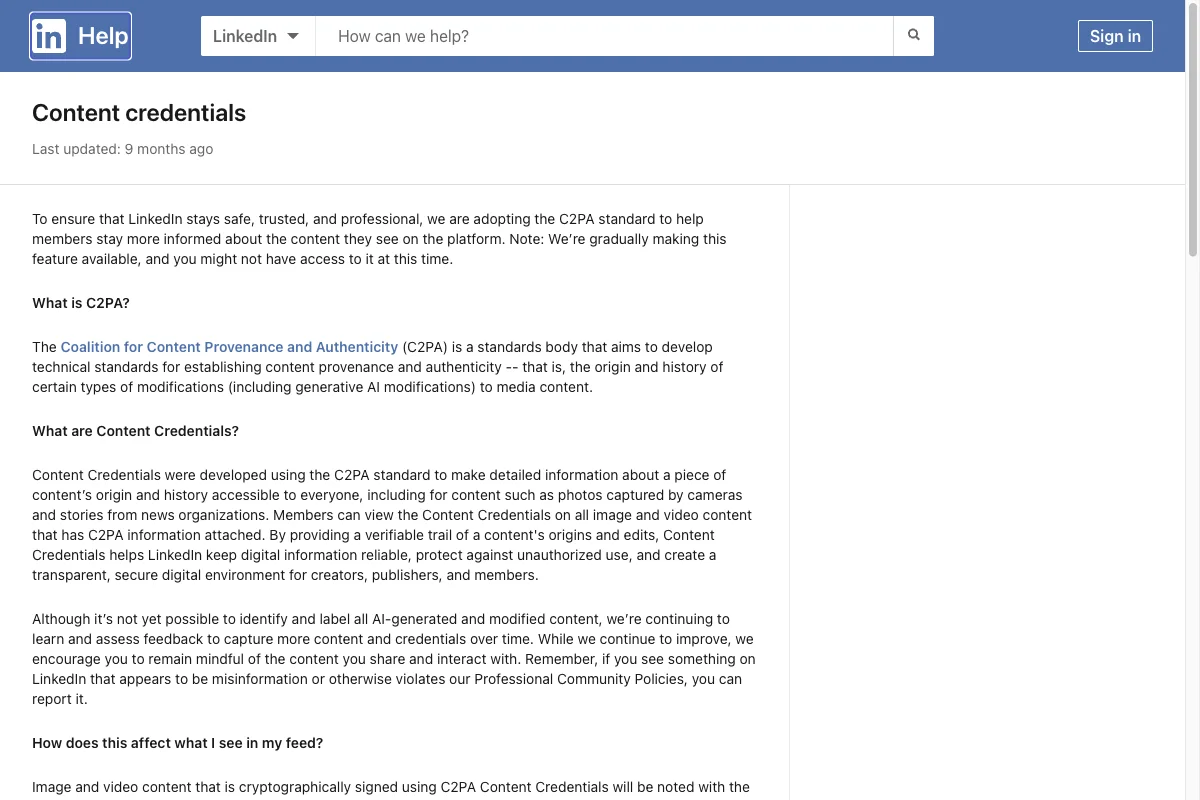
LinkedIn explicitly notes that this method cannot identify every piece of AI content. No automatic C2PA label appears when the metadata is missing. The LinkedIn help page explains the feature in more detail.
7.5 X
X currently documents global rules against deceptive, manipulated media. The platform can label such posts as manipulated, restrict their reach, or remove them.
The global X help center does not document a general voluntary AI upload switch comparable to YouTube or TikTok. Do not rely on an automatic label. Add a required notice prominently to the image, video, or post text yourself.
8. What happens if you fail to disclose AI content?
Article 99 of the EU AI Act sets a maximum fine of €15 million for an infringement of Article 50. For companies, the cap can reach 3% of total worldwide annual turnover for the preceding financial year, with the higher amount generally applying.
The rule works differently for small and medium-sized enterprises and small mid-cap enterprises. The lower of the two caps applies to them. Authorities must also consider proportionality, severity, duration, intent, cooperation, and economic consequences.
According to an updated notice from the German federal government, Germany's AI Market Surveillance and Innovation Promotion Act is now in force. The Bundesnetzagentur has the main market surveillance role where no specialist authority is responsible.
Platform policies and other laws add another layer. A correct AI label does not make a violation of personality rights, misleading advertising, data protection law, or copyright legal.
9. My practical rule of thumb
First check whether a statutory duty or platform policy actually applies. Then make the disclosure early, visible, and understandable enough that nobody has to search for it.
For text, substantive human review is often the more important step. It prevents factual errors and generic AI output, and it can also determine whether the special public-interest text disclosure applies.
I would not choose the narrowest possible interpretation for deepfakes, cloned voices, or realistic fabricated scenes. A short, plain notice costs little and helps prevent mistrust among your audience.
Frequently Asked Questions
No. Article 50 of the EU AI Act does not require a visible label on all AI content.
Professional deployers primarily have to disclose deepfakes and AI-generated or AI-manipulated text about matters of public interest. The text disclosure does not apply when the content has undergone human review or editorial control and a person or company holds editorial responsibility. Platform rules can go further.
Usually not if you genuinely edit and review the text.
The statutory text disclosure applies to published content that informs the public about matters of public interest. Even then, the exception applies when a person performs a substantive human review or the text undergoes editorial control, provided that a person or company assumes editorial responsibility. A spellcheck alone is not enough.
Not automatically. Article 50(4) applies to deepfakes used by professional deployers.
Deepfakes are realistic AI images, audio, or video that resemble real or plausible people, objects, places, entities, or events and could falsely appear authentic. An obviously fantastical AI image is not automatically a deepfake. YouTube, TikTok, Meta, or another platform may still require a label.
The disclosure must be clear, distinguishable, accessible, and visible no later than the first interaction or exposure.
A visible text notice can work for an image or article. Audio may need a spoken notice, and a video can show a label when playback begins. The EU also offers optional icons. Machine-readable metadata alone does not fulfill a deployer's visible disclosure duty.
People must be told that they are interacting with an AI system at the beginning of the first interaction, unless this is obvious in the specific context.
Article 50(1) places this system duty on the provider. You may be the provider when you develop a chatbot or have one developed and place it on the market under your name. Even with a third-party widget, check whether the notice actually appears on your website.
Content created and made available before August 2, 2026, does not need a retroactive label under the Commission's final guidelines.
The Commission encourages voluntary retrospective disclosure where it is practical. Content first made available on or after the deadline must follow the applicable rules.
An infringement of Article 50 can lead to a fine of up to €15 million or, for a company, up to 3% of its total worldwide annual turnover for the preceding financial year.
The lower cap applies to small and medium-sized enterprises and small mid-cap enterprises. Authorities must also consider the nature, severity, duration, and consequences of the infringement. Platforms can separately add labels, remove content, or restrict accounts and monetization.