AI Text Detector
Analyze texts and detect whether they were written by AI or a human. Including a detailed comparison of 13 AI detectors.
0 words
You can try the free AI text detector above without signing up. Treat its result as an estimate, not proof of who wrote a text.
Below, you will also find the earlier comparison of 13 AI detectors with 585 individual tests. Those results describe the older tests, not the tools’ current accuracy.
For my latest hands-on results, how I tested the tools, and explanations of detection methods, text watermarks, and writing clues, read my AI text detector comparison.
Detect AI Text: Guide and Comparison
Everything you need to know about AI text detection
We put 13 of the most well-known AI detectors through their paces. For this, we generated 30 texts each with 5 different AI tools and checked whether the detectors recognize them as AI texts. In total, we conducted 585 individual tests.
Summary:
- Originality.ai leads with 99% detection rate for both non-English and English texts
- CopyLeaks is the best free alternative with 80% detection rate and only 6.7% false positives
- Polished language, perfect grammar, and uniform formatting do not prove that a text was written by AI
*The "Non-English" detection rate was tested using German texts as a representative sample. The rate is derived from three metrics: (1) Highly likely AI text (75% to 100%), (2) Possibly AI text (25% to 74.9%), (3) Highly likely not AI text (0% to 24.9%).
3.1 Originality.ai
Originality.ai is one of the most popular and well-known AI detectors on the market. According to its own claims, it can detect AI text created with GPT-3, GPT-3.5, GPT-4, and Google Bard.
In our first test in January 2023, it still ranked as the second-best tool. It was able to detect 12 of 15 AI texts with high certainty, two partially, and only one not at all.
Since then, the developers have significantly improved the tool:
In the current test from July 2024, it was able to detect 15 of 15 English AI texts and 14 of 15 non-English AI texts (tested with German), landing in first place.
Experiments have also shown that Originality.ai is now much harder to trick. The tool also detects AI texts very well where typical obfuscation methods such as adding punctuation, spelling and grammar errors, synonyms, or rewriting by AI tools have been applied.
The only drawback:
The rate of false positive results, i.e., human texts that Originality.ai incorrectly classified as AI texts, was slightly elevated at 2 of 15 texts (13.3%) compared to other detectors.
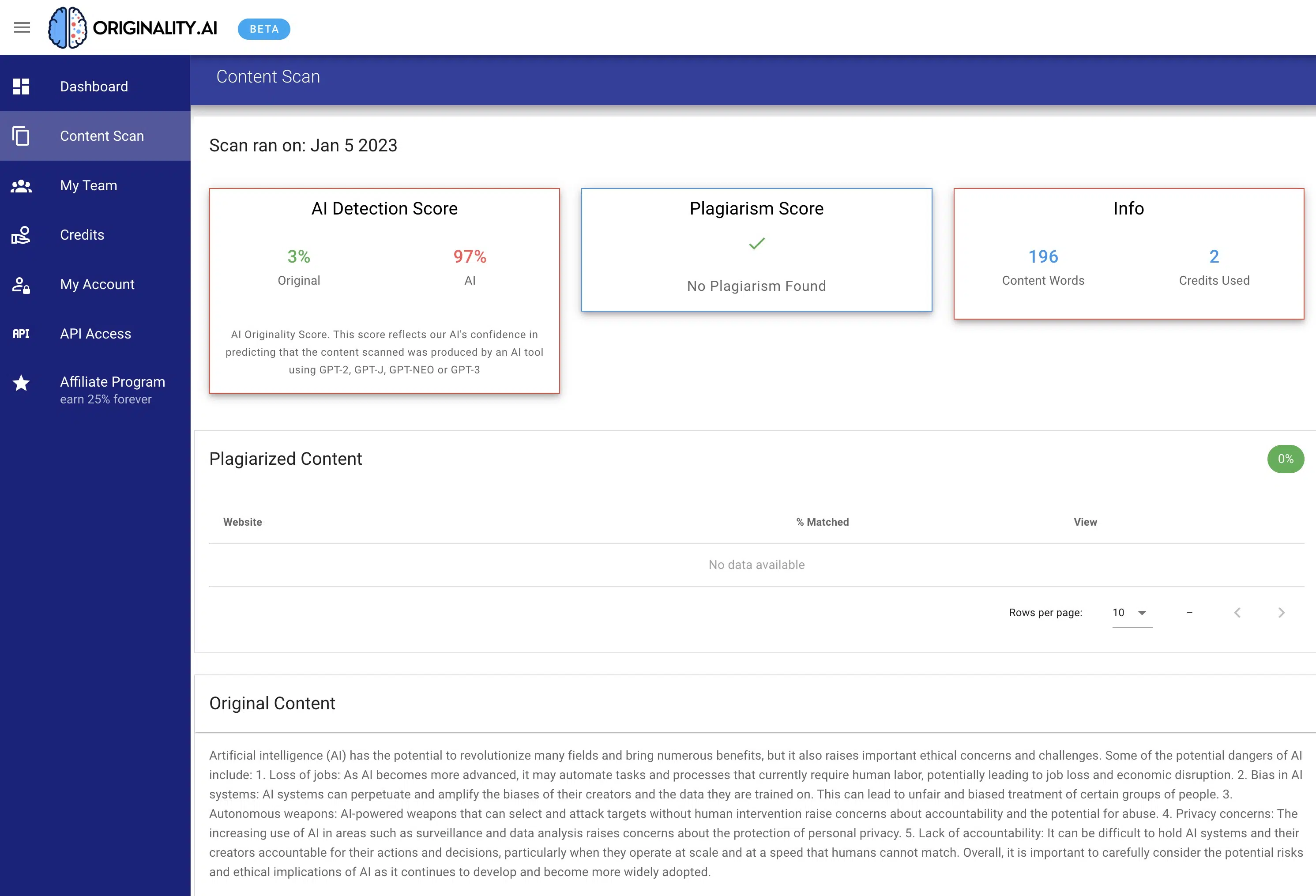
Originality.ai additionally offers a plagiarism checker that can be run simultaneously with the AI detector.
Plagiarism and AI checking is usually quick and the result is clearly displayed:
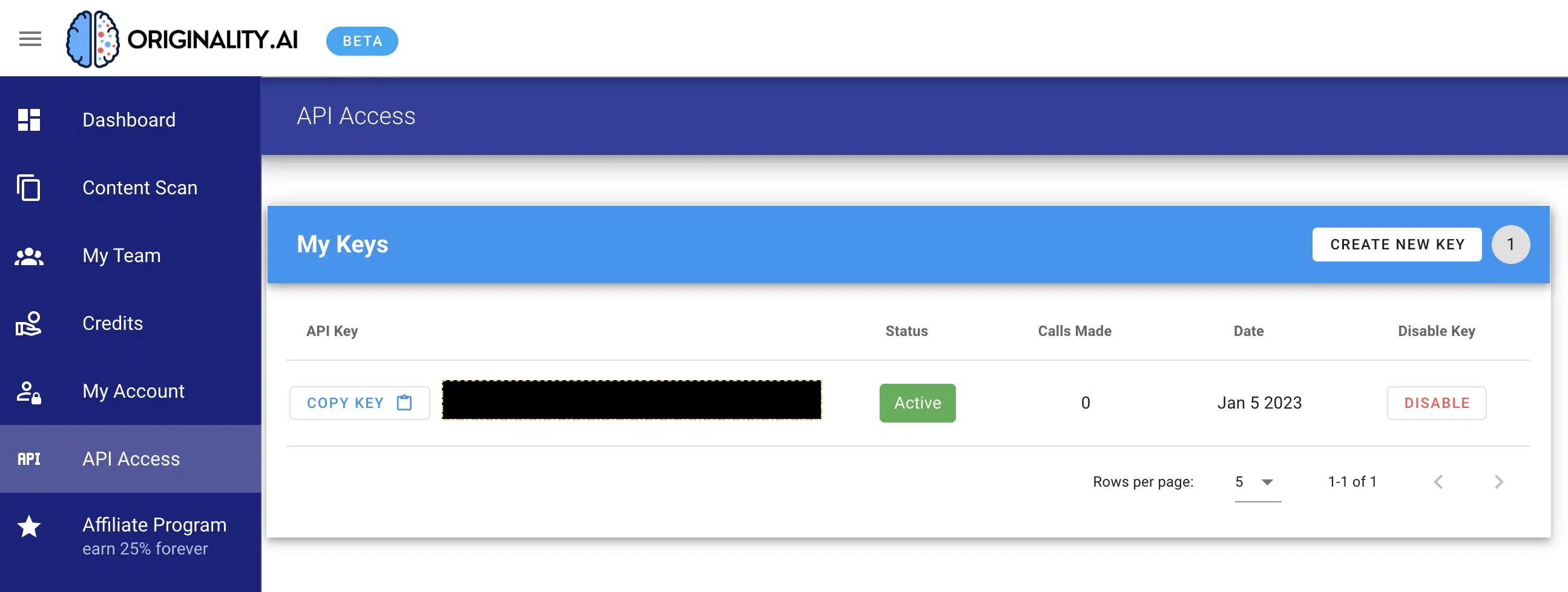
For those who want to check text in bulk or in their own software, there is also an API:
Originality.ai Pro costs $14.95/month or $12.95/month with annual billing. It includes 2,000 credits per month.
One credit scans up to 100 words for AI content. Running AI detection and plagiarism together uses two credits per 100 words.
3.2 CopyLeaks AI Content Detector
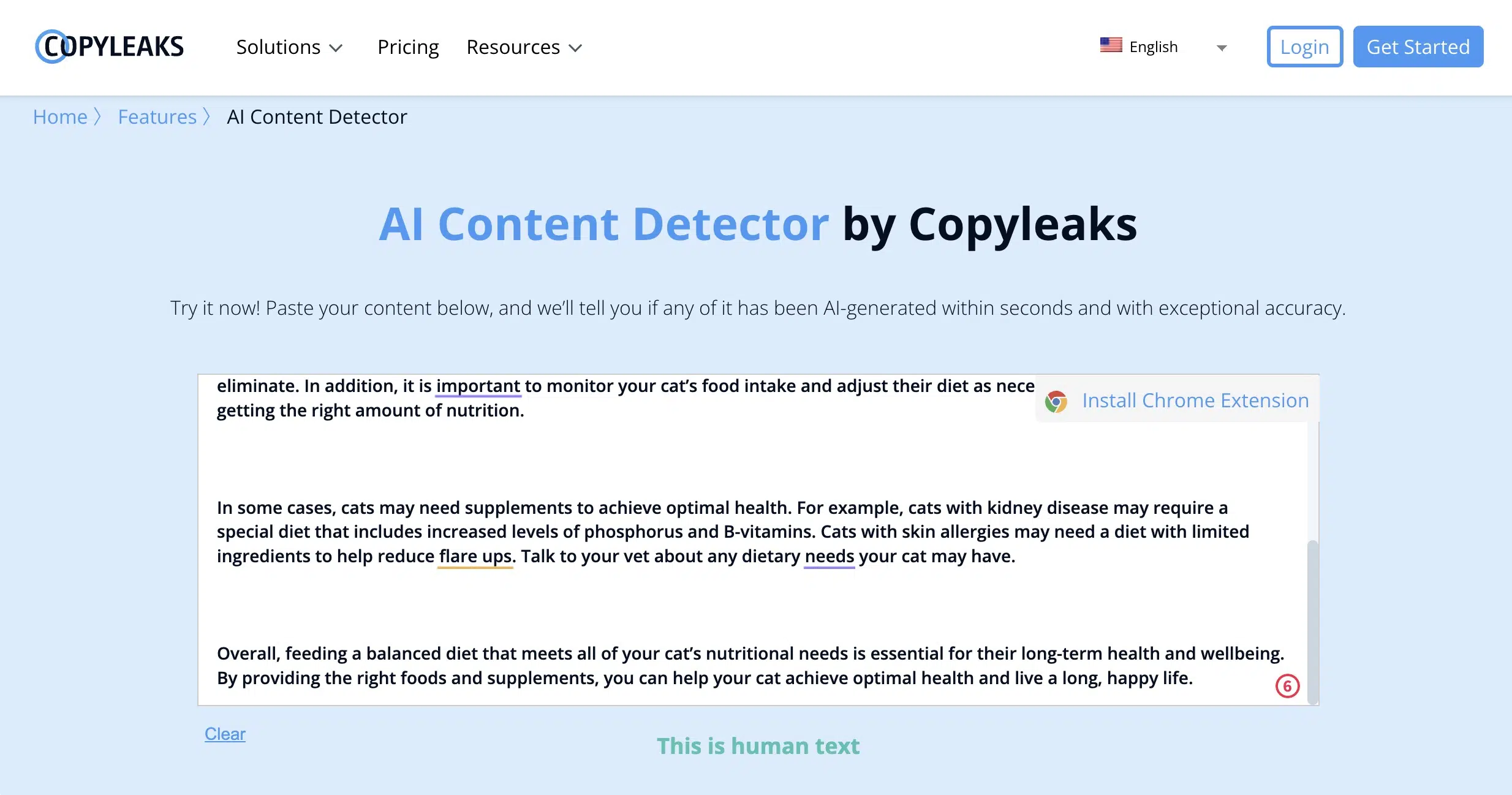
The AI Content Detector from Copy Leaks is the second-best tool for detecting non-English AI text.
It detected non-English AI text in 12 of 15 cases, which corresponds to a detection rate of 80%, while for English AI texts the detection rate was only 60%, which is a mediocre result.
The detector itself is easy to use and delivers quick results. There is even a Chrome Extension available recently.
Unfortunately, the tool does not output precise detection data, only whether it is human-made or AI-made text.
3.3 Sapling AI Content Detector
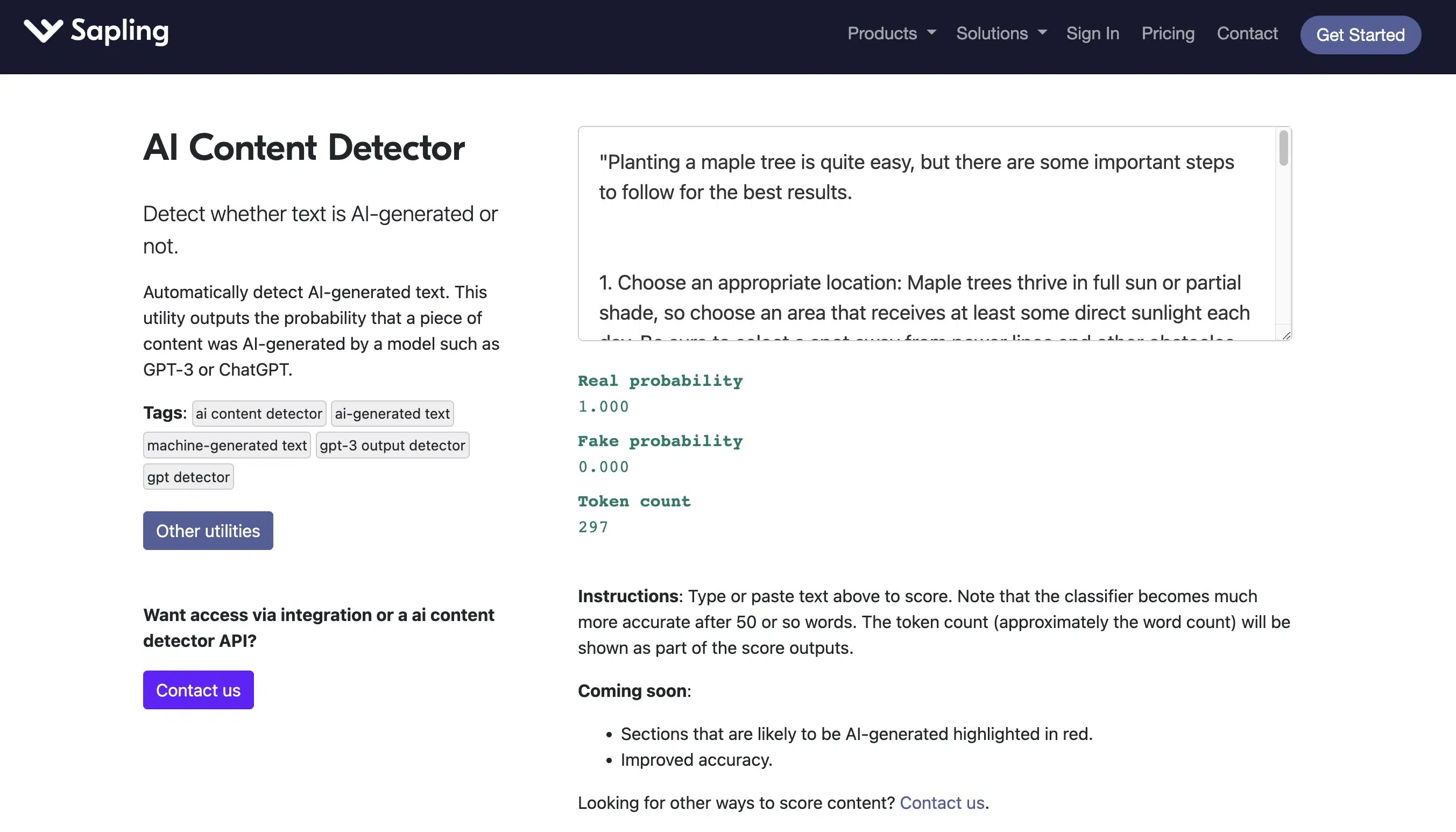
The free AI Content Detector from Sapling also achieved a very good result in the test.
Like Originality.ai, Sapling also improved compared to the first test from January 2023. While the tool detected 12 of 15 English AI texts last year, it now detected 13 with high probability, one with medium probability, and only one not at all.
For non-English AI texts, the result is significantly worse, where the tool only detected 6 with high probability, one with medium probability, and 8 not at all.
The detector is minimalist and is one of the tools that delivers results fastest.
I really like that the text check starts as soon as you enter text and you do not need to click a button afterward.
3.4 Crossplag AI Content Detector
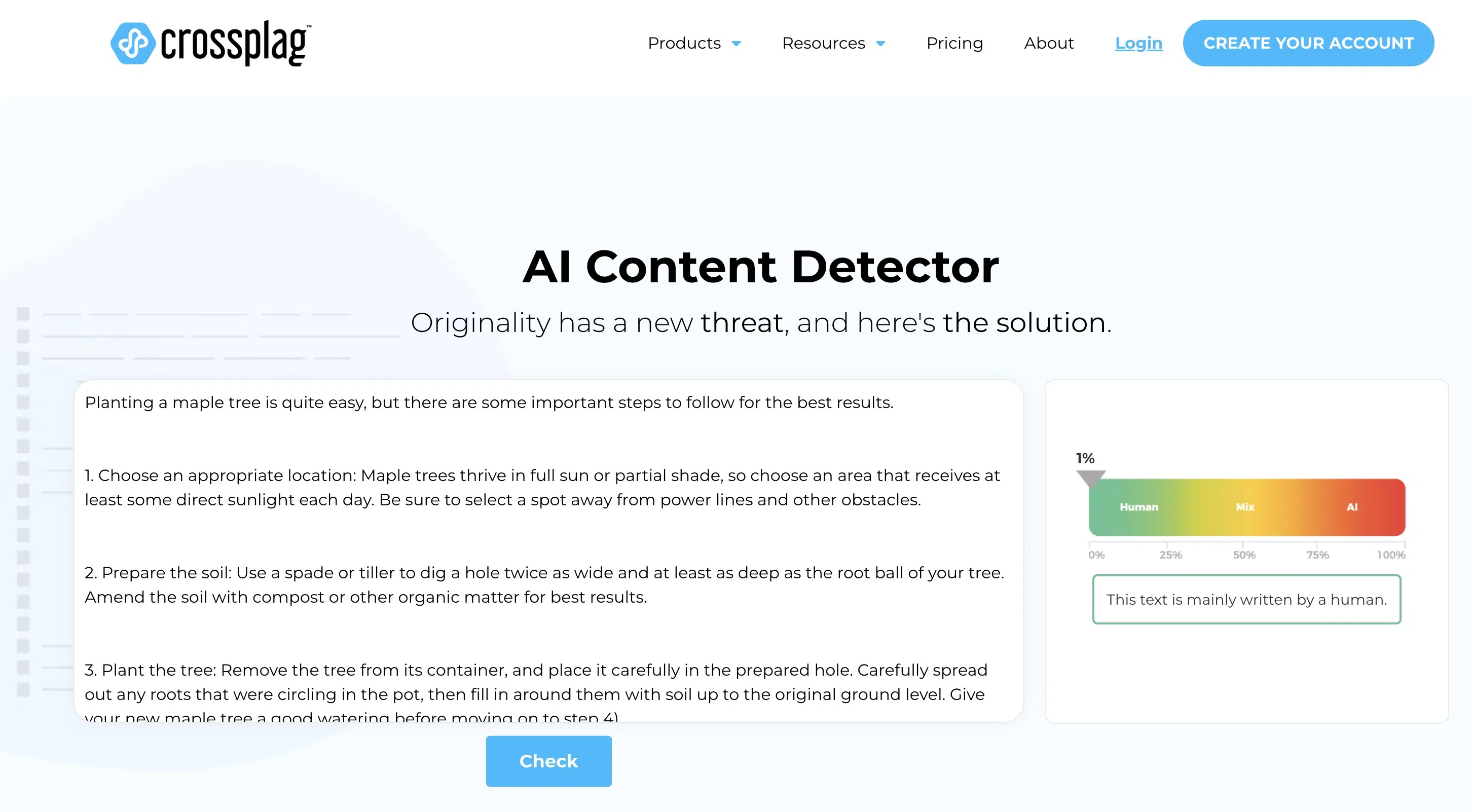
The AI Content Detector from Crossplag achieves a similarly good result in the test as the detectors from Sapling and Content at Scale, with 12 of 15 detected English AI texts.
For non-English AI texts, Crossplag also has its problems and only detected 5 of 15 with high probability. Eight texts were not detected at all and one was detected with medium probability.
The tool can be used for free. If you test texts repeatedly, you are prompted to register, but you can continue using the detector for free afterward.
3.5 AI Detector Pro
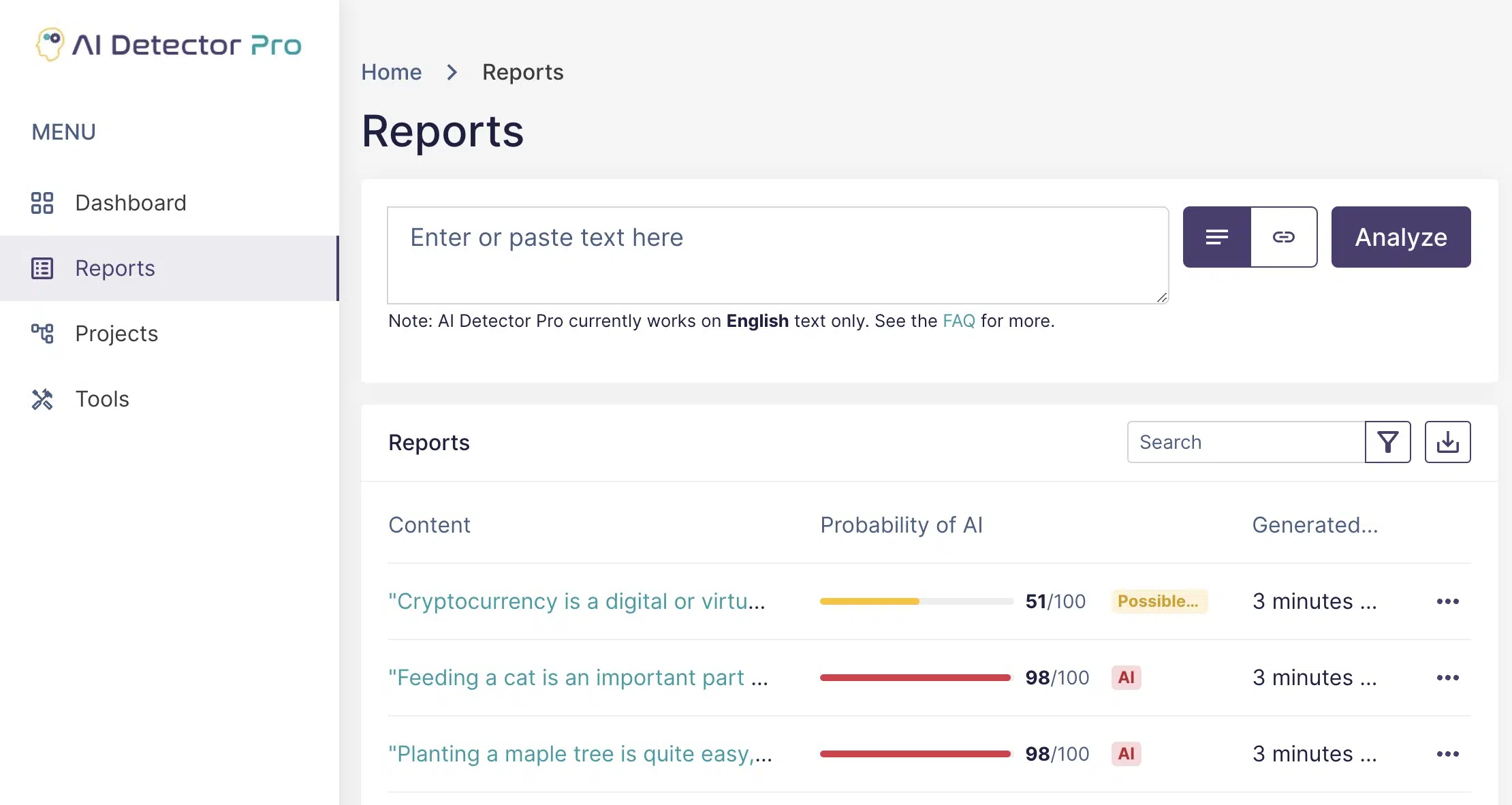
AI Detector Pro is one of my favorites in the test with English AI texts, alongside GPTZero and Originality.ai. It achieved the same detection rate as GPTZero:
Of 15 AI texts, it clearly recognized 13 as such. It did not recognize one at all and one with medium probability.
With non-English AI texts, the result is much worse, where the tool only recognized 4 with high probability and the remaining 10 not at all.
It stands out with a modern and easy-to-use interface. In addition, the test results are generated very quickly.
Unfortunately, you can only make 3 free queries per day and then have to book a paid plan.
AI Detector Pro also offers an API and can be used as white label. However, there are no prices listed either on the website or in the customer area.
3.6 GROVER
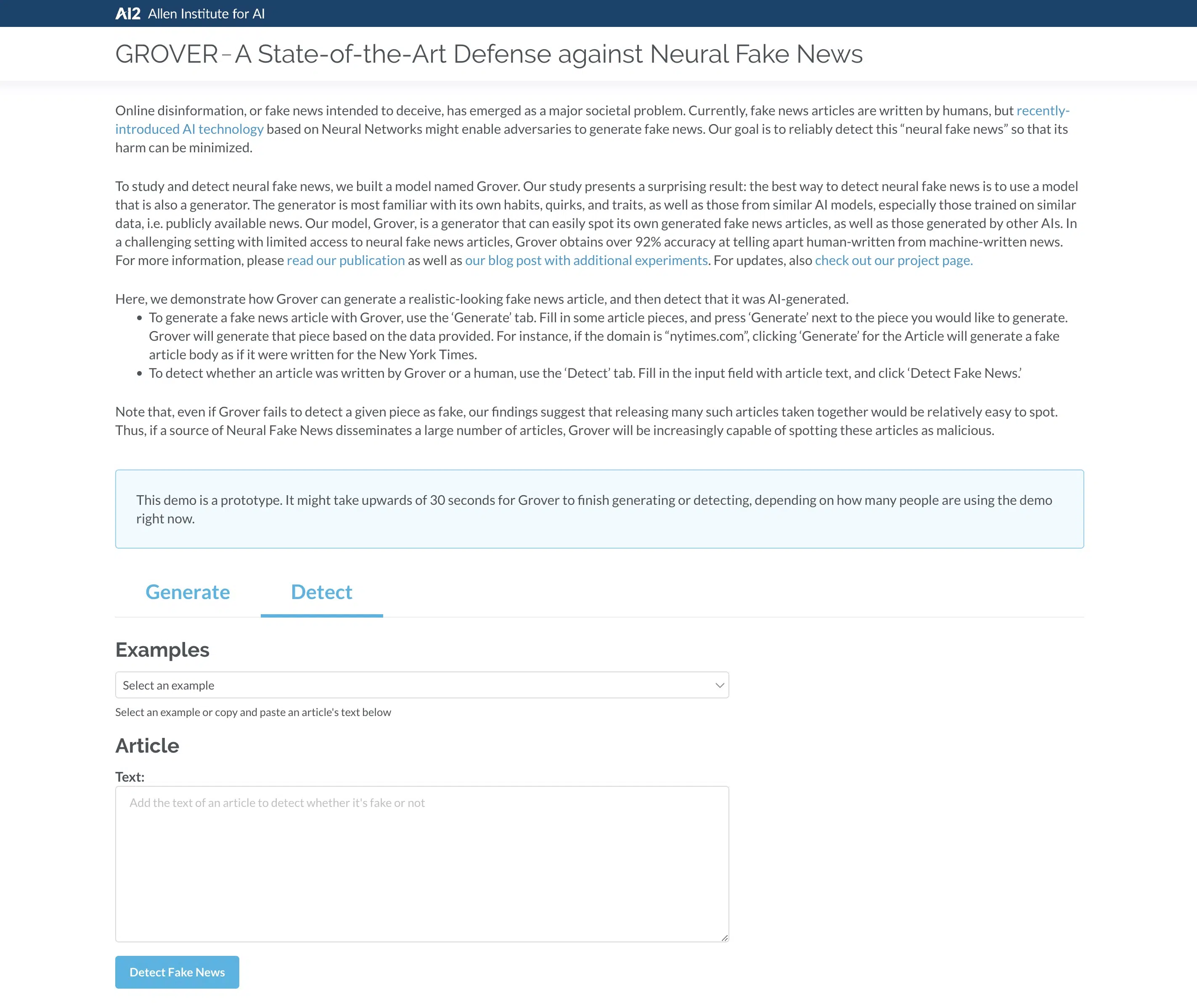
GROVER is a language model developed by researchers at the University of Washington and the Allen Institute for Artificial Intelligence (AI2).
It is supposed to distinguish AI-generated news from real news.
However, the free demo of the language model (no longer available) did not perform well at detecting AI text:
It could only detect 4 of 15 AI texts. For two texts that the tool recognized as human-written, it at least output a lower probability for its assessment.
The poor detection rate is probably due to the fact that the tool (as well as the associated research paper) dates back to 2019 and has not been improved since then.
3.7 KAZAN SEO AI GPT3 Detector
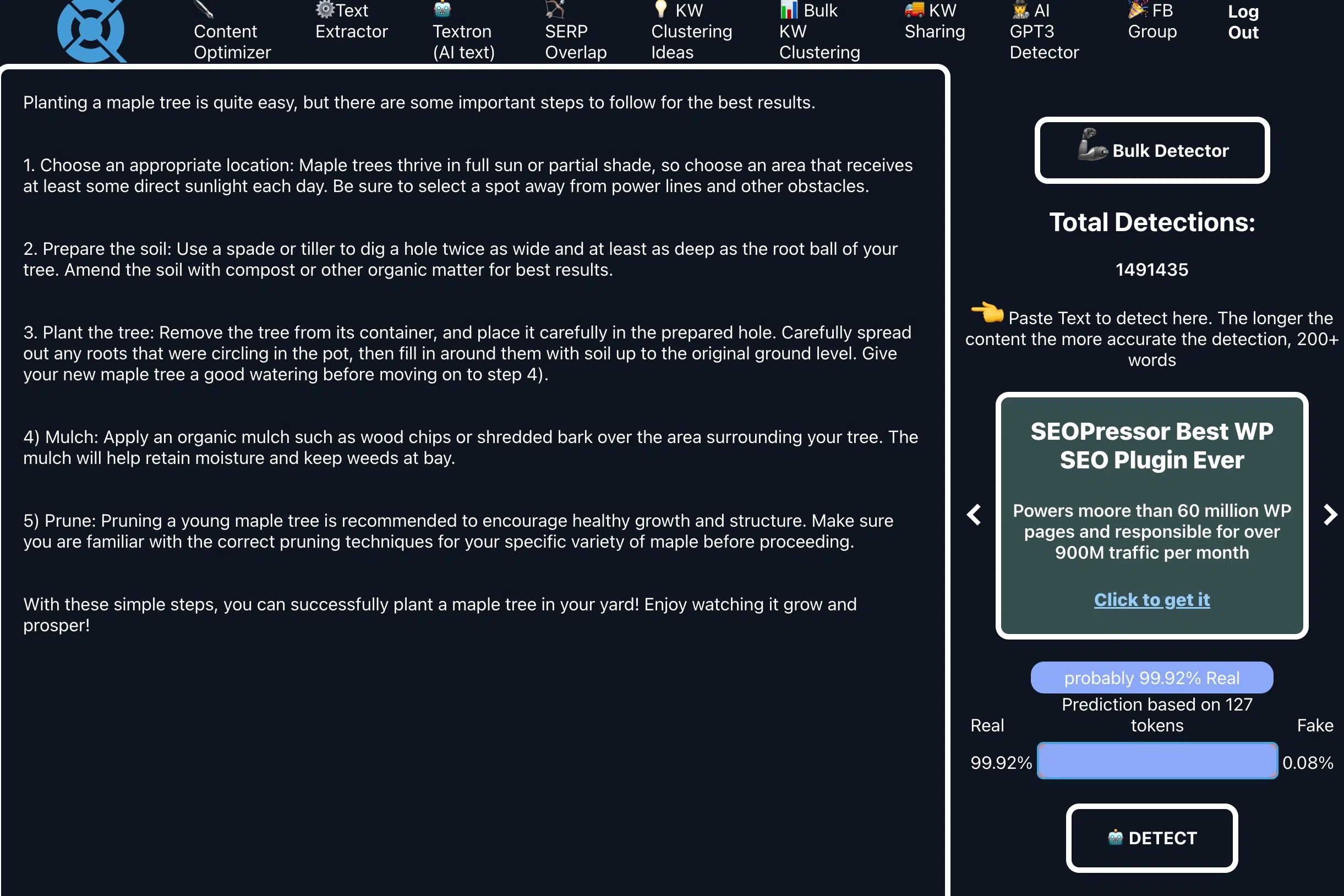
The AI GPT3 Detector from KAZAN SEO detected two thirds of all AI texts, which is okay but not amazing.
Four of the five texts came from Jasper, and the one it did not recognize came from ChatGPT. Of the non-English AI texts, the AI GPT Detector recognized only one with high probability.
It was negatively noticeable in the test that about every second or third test fails and the tool indicates that the server is overloaded.
Like other KAZAN SEO tools, the AI GPT Detector can be used for free, but it requires registration.
3.8 GPTZero
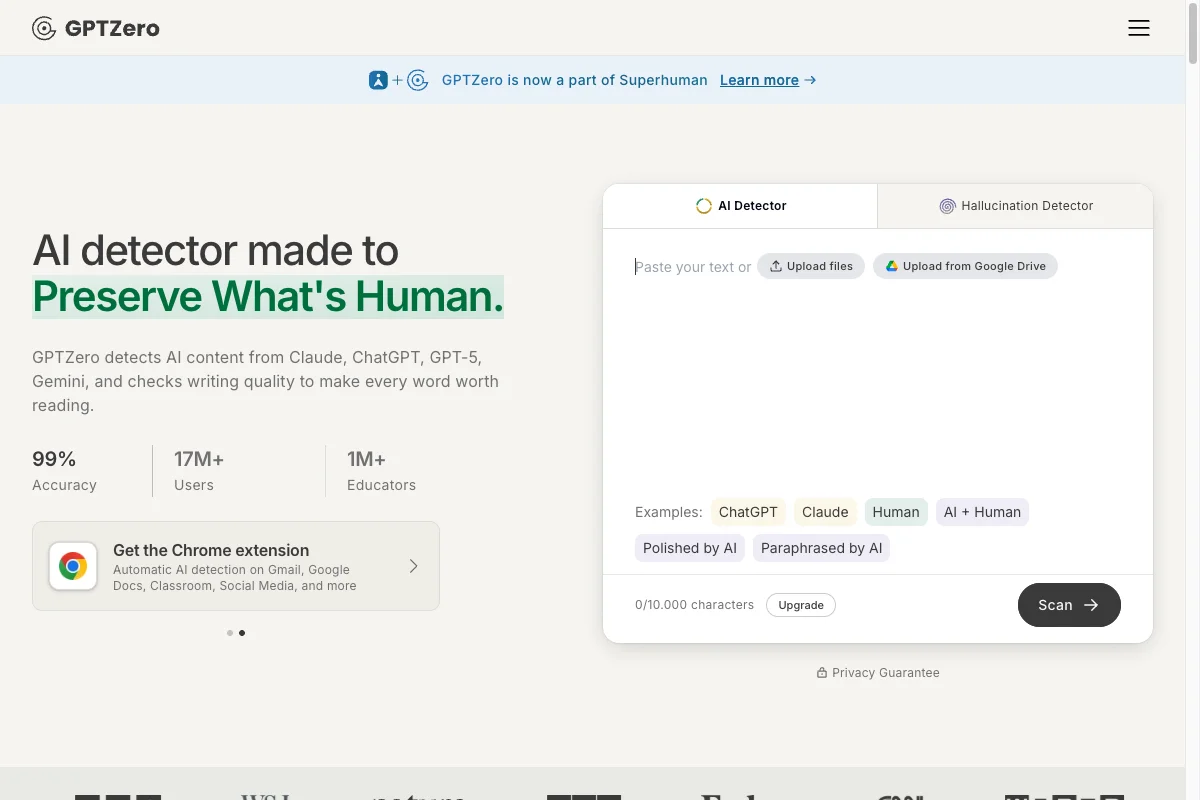
I checked GPTZero with six German and English factual texts on September 24, 2026. It correctly classified the four purely human- or AI-written texts.
Human was the top label for both mixed texts. The German result was close, with 51% human versus 49% mixed. My AI detector comparison has all six results.
I could use the tool for free. My account showed 10,000 monthly credits, and the input field allowed 10,000 characters. Each scan cost one credit per word.
3.9 Content at Scale AI Content Detection
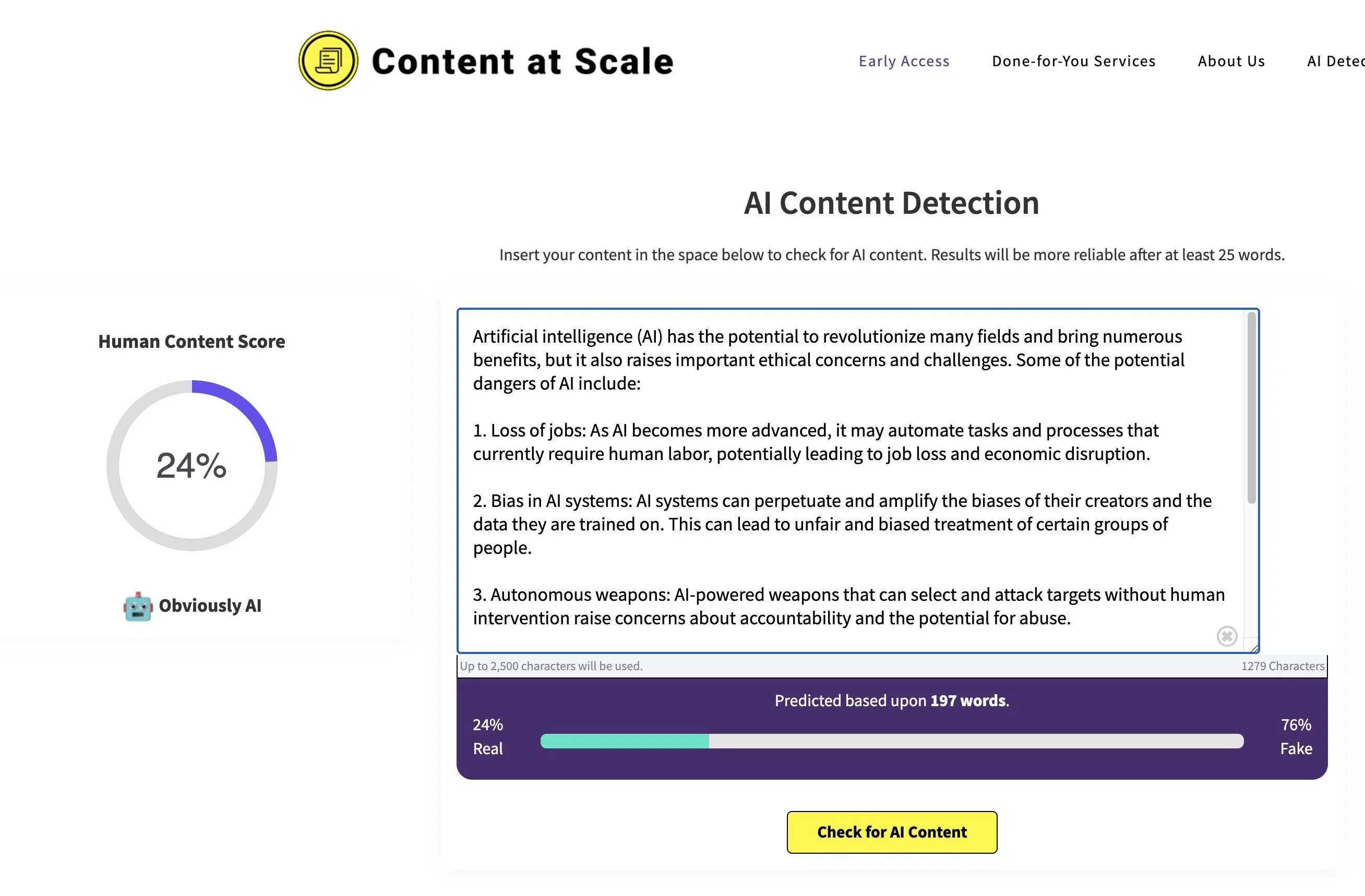
The AI Content Detector from Content at Scale performed as the third-best tool in the test. It was able to detect 12 of 15 AI texts as such. Non-English AI texts were detected incorrectly 100% of the time.
You can test texts up to 2,500 characters, which corresponds to about 380 to 500 words in English.
It offers a nice user interface with a bar display showing which direction a text goes. It also shows you the words and character count of the entered text, which should be standard but is not offered by all detectors.
3.10 Huggingface GPT-2 Output Detector
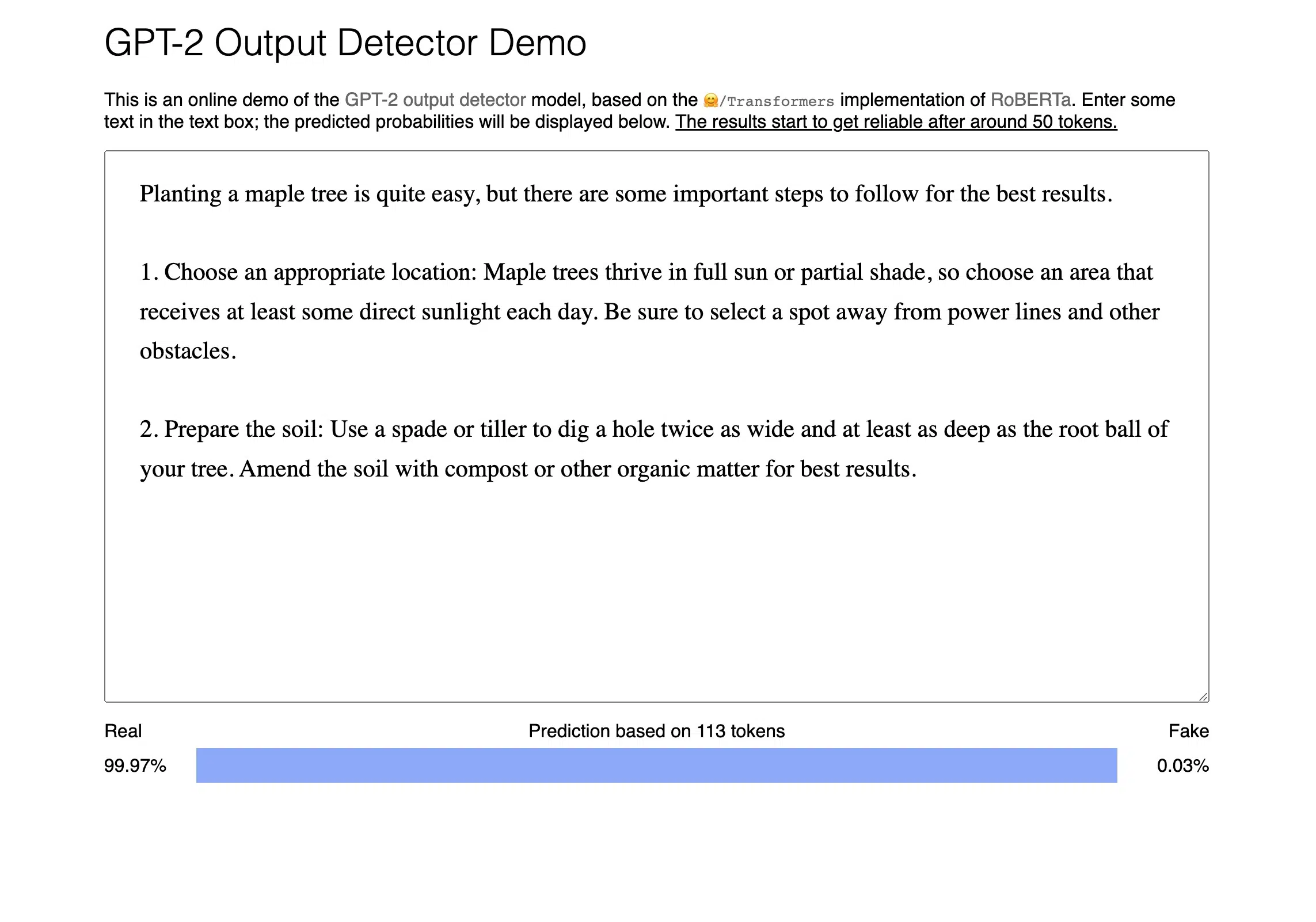
The GPT-2 Output Detector from Huggingface is based on a RoBERTa model that was fine-tuned with the output of a GPT-2 model provided by OpenAI.
In a freely available online demo, you can test texts in the browser and get a bar below the input field showing the probabilities that a text was written by AI and by humans.
In the test, it recognized 10 of 15 AI texts with high probability and one only with lower probability. However, this is not surprising either, because the AI texts were generated with GPT-3.x.
Unfortunately, the Output Detector was not particularly reliable in the test. Every second test caused the detector to freeze or display a server error.
3.11 Writer.com AI Content Detector
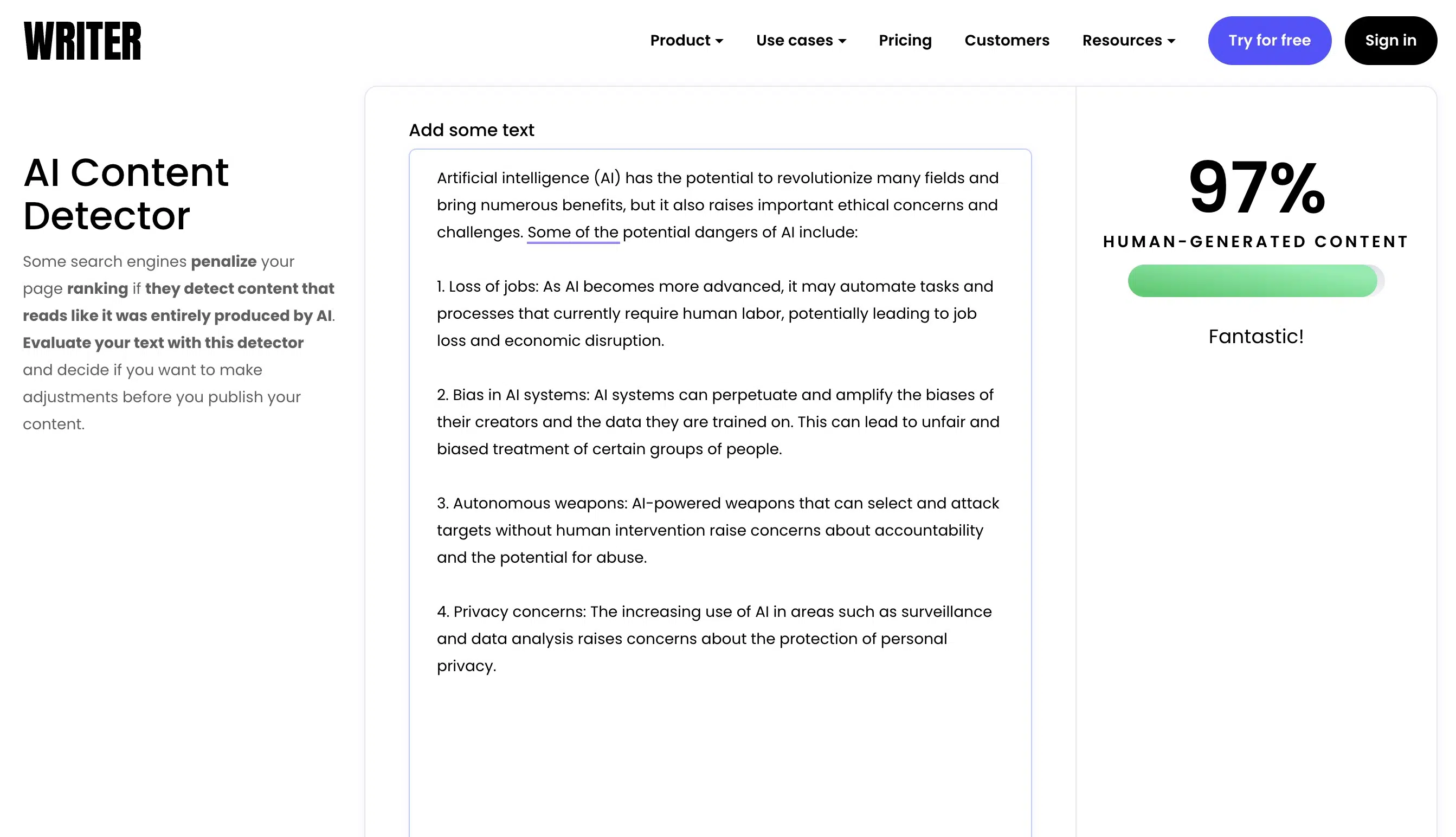
The AI Content Detector from Writer.com is one of the three worst tools in the test. It could clearly recognize only 6 of 15 AI texts.
However, the tool must be given credit for recognizing 5 AI texts partially and only 4 not at all.
In addition, the tool is easy to use and usually delivers quick results.
Non-English AI texts are not recognized by the tool at all.
3.12 Unfluff
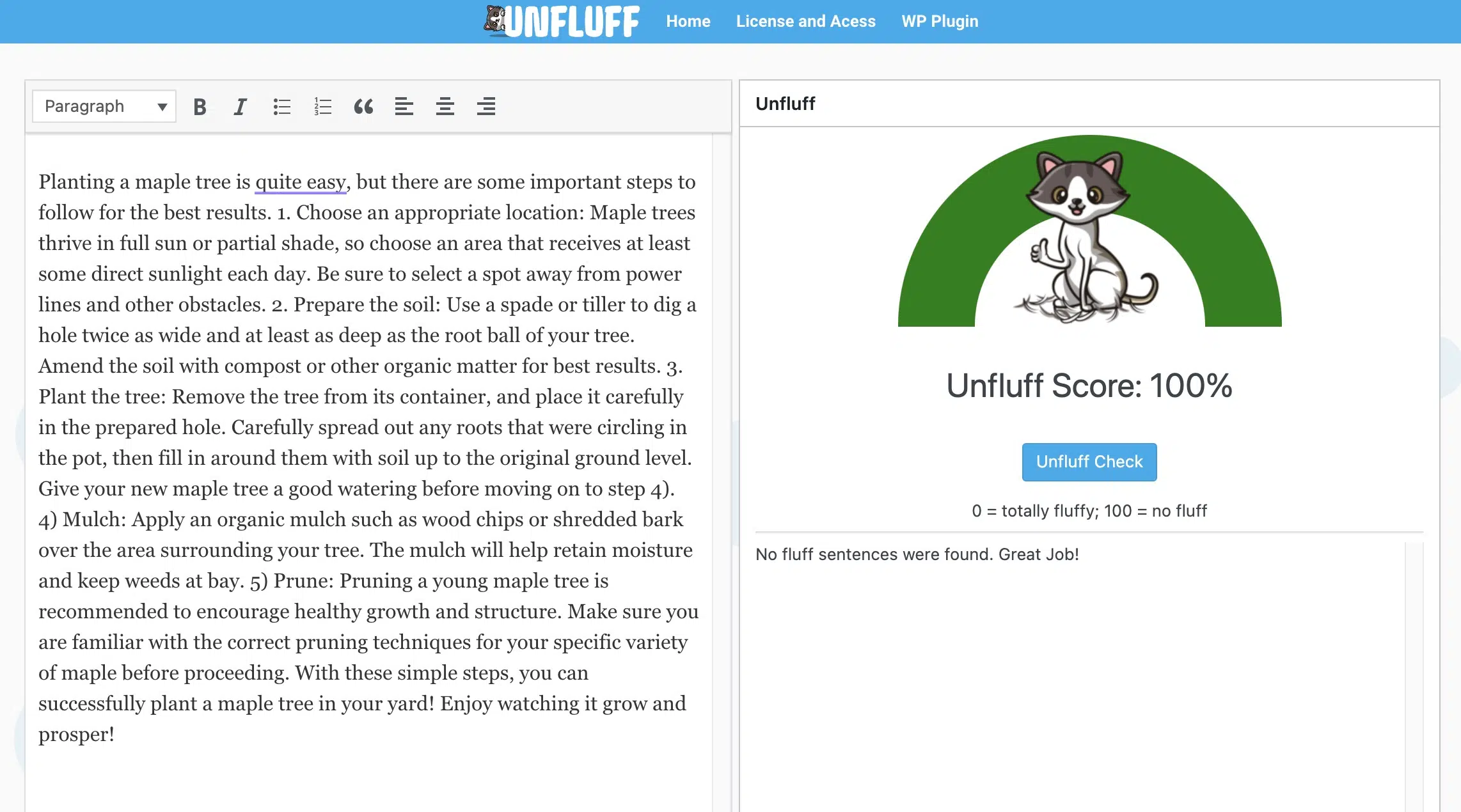
Unfluff is a free app that analyzes texts for readability. It is supposed to detect not only unnecessary filler words or overly long sentences but also AI text. Unfluff is also available as a WordPress plugin.
In practice, this unfortunately works little to not at all.
For 10 of 15 AI texts, the Fluff Score was 100 out of 100. For 5 of 15 texts, the Fluff Score was under 100 but was between 76 and 99%, so you cannot call that "detected."
Another annoying drawback:
The app is extremely slow. So slow that it is almost unusable.
3.13 GLTR (Out of Competition)
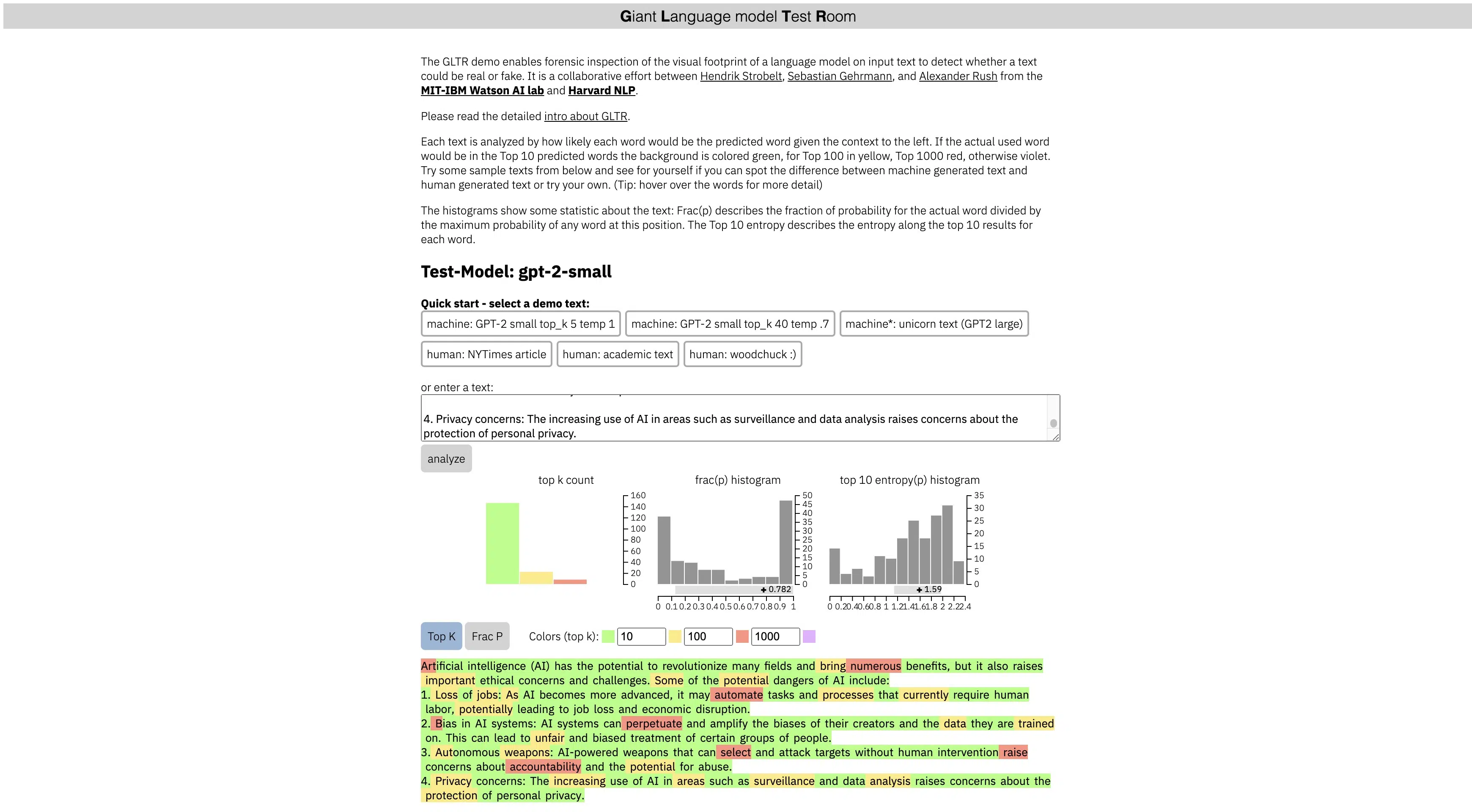
GLTR (short for Giant Language Model Test Room) is a joint project from the MIT-IBM Watson AI Lab and HarvardNLP.
Similar to the GPT-2 Output Detector, the tool has access to GPT-2 (in the 117M version) and analyzes text inputs to determine what GPT-2 would have predicted at each point.
Unlike other detectors, however, it does not output probabilities for whether a text was written by a human or an AI tool (which is why it is only partially comparable to other tools and is out of competition in the test).
Instead, it overlays a color mask on the text that shows how likely each word would be in a text generated by GPT-2:
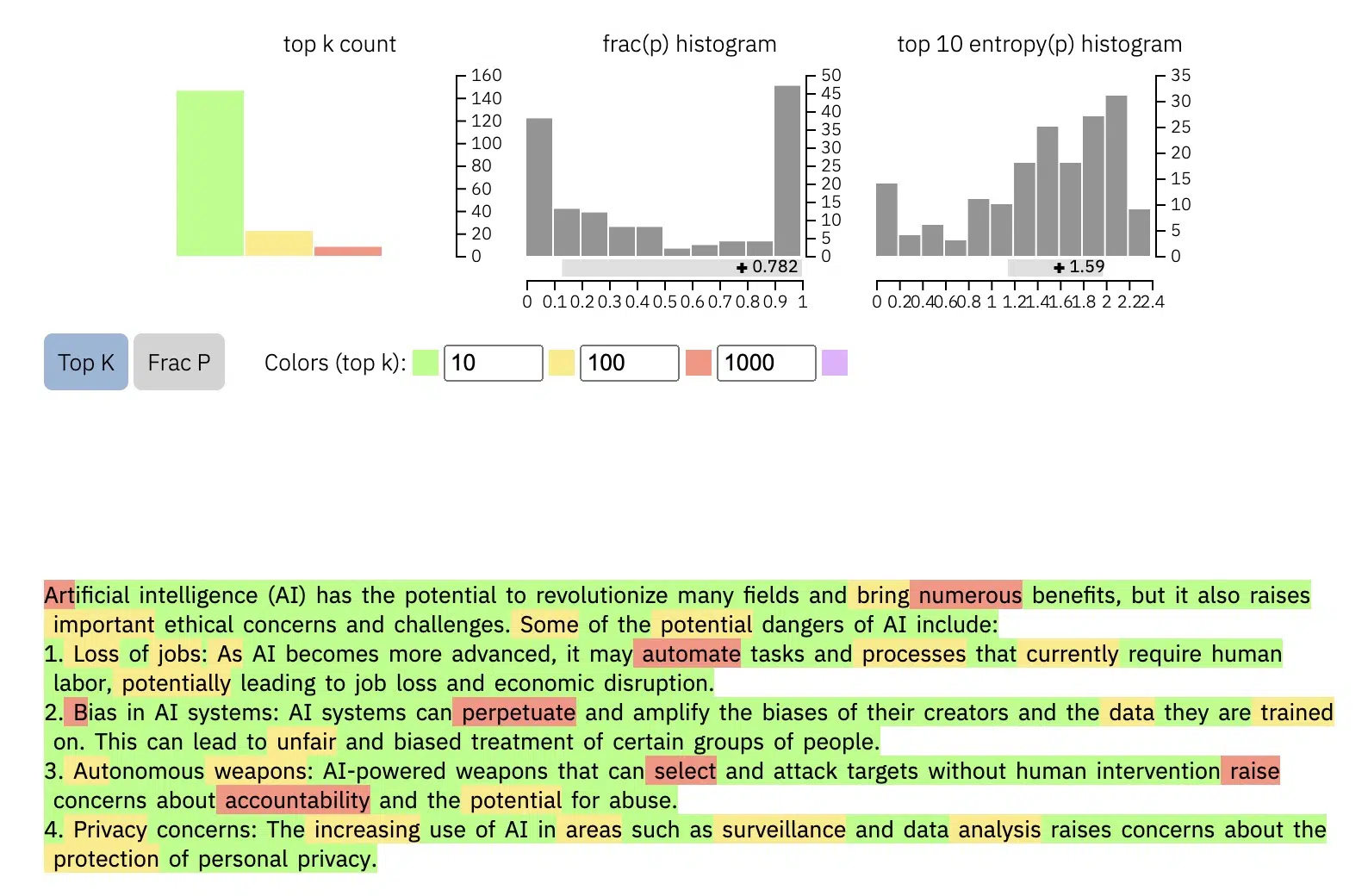
A word that is among the most likely words is highlighted green (Top 10), yellow (Top 100), red (Top 1,000), and the rest of the words purple.
That means the more green and fewer red and purple words a text contains, the more likely it was written by GPT-2.
You can use the tool as a demo for free.
Originality.ai

AI-content and plagiarism detector for editorial teams and agencies, with team features and detailed reports.
Try NowPangram

AI detector for AI-generated, AI-assisted, and human-written text segments, with multilingual detection and an API.
Try Pangram* Affiliate links: If you make a purchase through one of these links, we receive a commission at no extra cost to you.
Frequently Asked Questions
Everything you need to know about our AI Text Detector
Changelog
Detected AI Model and Pattern Analysis Now Display Correctly
- Fixed: The detected AI model family (ChatGPT, Claude, Gemini) now shows as a badge with every result
- Fixed: The Detailed Pattern Analysis with all 19 metrics now appears in full below every analysis result
- Both evaluations were already being calculated, but were never actually shown before
8 More Research-Based Metrics (Stylometry & POS Analysis)
- Adjective/Adverb Analysis: AI uses more adjectives but fewer adverbs than humans
- Adj./Adv. Ratio: High ratio = strong AI signal (2025 research)
- Punctuation Patterns: Exclamation density (ChatGPT "loves" !), question mark analysis
- Passive Voice: AI uses significantly more passive than active voice (contrary to expectation!)
- Avg. Word Length: Proxy for vocabulary complexity
- Numbers/Symbols Density: AI uses more numeric content
- Now 19 scientifically validated metrics total (based on stylometry research)
- New UI: Green cards for research-based 2025 metrics
5 New Scientifically Validated Metrics
- TTR (Type-Token Ratio): Measures lexical diversity - low values indicate AI
- 3-Gram Repetition Analysis: Detects repeated 3-word sequences (AI repeats more often)
- Sentence Length Variance (Standard Deviation): Low values = uniform AI sentences
- Flesch Reading Ease: Evaluates text complexity (0-100 scale)
- Personal Pronoun Density: Measures personal tone (AI uses less I/You/We)
- All new metrics based on 2025 AI detection research
AI Model Detection & Extended Pattern Analysis
- New feature: Detection of AI model families (ChatGPT, Claude, Gemini)
- Detailed pattern analysis with 6 key metrics (em-dashes, sentence uniformity, etc.)
- Recognition of over 40 model-specific phrases and AI-typical words
- New UI: Analysis results now displayed below the text input field
- Extended copy function with all pattern details
Initial Release
- Two-stage AI text detection with compression and language analysis introduced
- Confidence display including progress bar integrated
- FAQ section with frequently asked questions about the AI text detector added