I was a skeptic about AI voices for a long time.
Too robotic, too flat, too much like a train station announcement. Most of the tools I tried over the years sounded like a 2015 GPS unit. Fine for a demo, but nothing I'd seriously put on a YouTube channel or in an audiobook.
Then ElevenLabs kept coming up around me. Podcasters use it, dubbing studios talk about it, and in English-speaking AI circles it's been the reference point for years. So for this review I took another close look, not just clicking around the free plan, but using my own Creator plan, real scripts, and, where it mattered, real numbers I could check myself.
In this review I'll walk you through what I tested, where ElevenLabs genuinely impressed me, where it falls short, and who it's actually worth it for. And who, honestly, would be fine with something cheaper.
- ElevenLabs' flagship model is now called Eleven v3 and delivers the most natural AI voice quality I've heard so far, including audio tags like [whispers] and [laughs] that let you steer emotion right inside the script
- I tested the platform in depth on my own Creator plan: text-to-speech, Scribe (speech-to-text, 92 languages), Music v2, and the voice cloning and dubbing flows
- It's not just text-to-speech but a full audio platform with transparent credit billing (roughly 1 credit per character on v3), which can also get expensive fast under heavy use
1. My verdict up front
So you don't have to read the whole thing if you're in a hurry: ElevenLabs is, in my opinion, the best AI tool for voices on the market right now.
My grade: 9.2 out of 10.
The voice quality of Eleven v3 is at a level where I did a genuine double-take the first time I heard it. With the audio tags [whispers] and [laughs] I can steer emotion directly inside the script, something I haven't gotten from any other tool, and you can hear the difference yourself further down. On top of that, the biggest day-to-day win: I get text-to-speech, voice cloning, Scribe, a music generator, and dubbing in a single account, instead of paying for a separate tool for every task.
That said:
It's not the cheapest tool, and the credit billing can get expensive fast under heavy use, especially with the music generator if you set the length to "Auto" (more on that below, it caught me off guard too). The free plan also has no voice cloning, and Dubbing v2 is still in alpha. So if you only want to voice the odd blog post now and then, a leaner option usually does the job. But if you use voice seriously and regularly, there's barely any way around ElevenLabs right now.
Trying it costs you nothing, the free ElevenLabs plan is plenty for your first tests.
2. My test setup: what I actually did
For this review I didn't just poke around, I tested with real tasks on my own account.
My workspace is called "ElevenCreative" and runs on the Creator plan at $22/month, with the interface itself set to German. When I wrote this article, I had 16,748 of 131,000 credits used, with my allowance renewing on August 19. The Creator plan's base allowance is 121,000 credits a month, so the extra roughly 10,000 credits look like a promo or a rollover.
Specifically, I tested:
- Text-to-speech with Eleven v3, including audio tags, with real generations and traceable credit usage.
- Scribe (speech-to-text) using a real test file from my earlier transcription comparison.
- Music v2, including the song editor with sections, inpainting, and genre switching.
- The full voice cloning flow, both Instant and Professional (more on that below).
- The upload and configuration flow for Dubbing v2.
- The ElevenAgents dashboard with its full agent builder.
For anything you can actually listen to, I'm showing you real results from my account, some of them directly playable here. For voice cloning and dubbing, I walk you through the full flow and tell you where each feature stands today.
3. Text-to-speech: Eleven v3 and audio tags
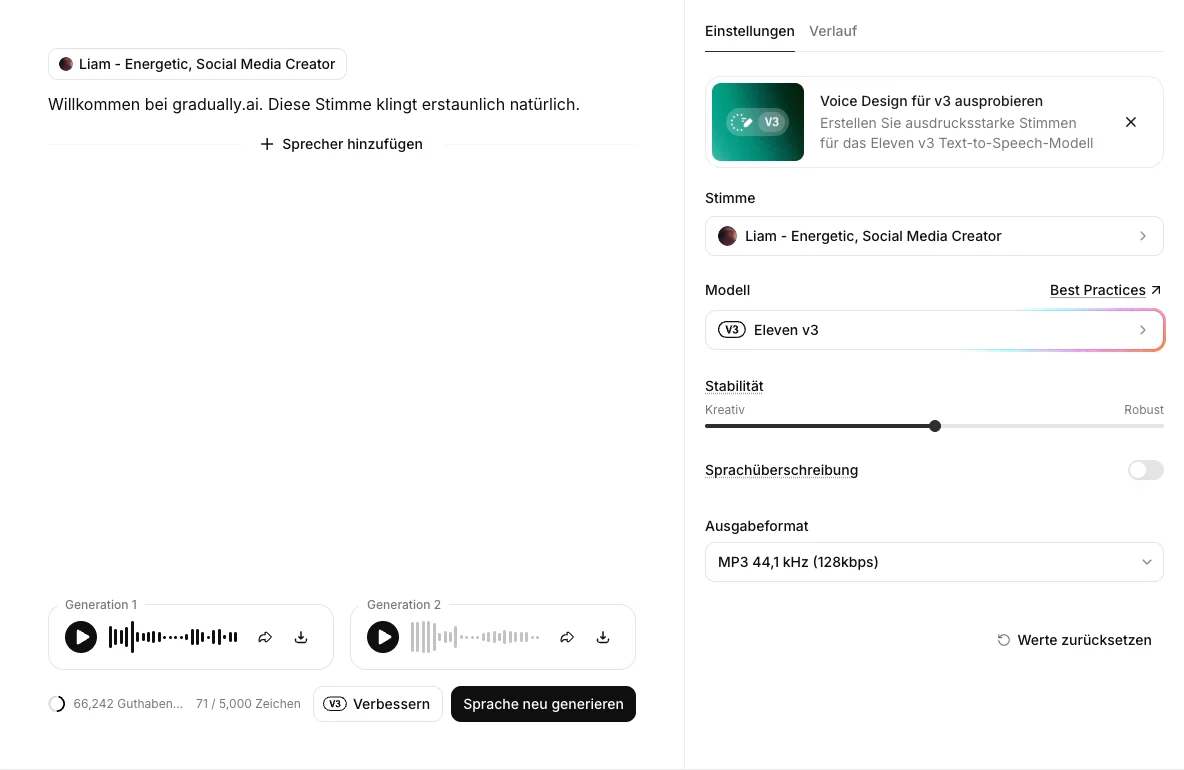
The core of ElevenLabs is now the Eleven v3 voice model. It covers 70+ languages, and by default it outputs MP3 files at 44.1 kHz and 128 kbps, with WAV and other formats selectable. Each generation allows up to 5,000 characters with v3, and you automatically get 2 variants to choose from.
For the voice, I used "Liam, Energetic, Social Media Creator," freely selectable from the library, plus a stability slider between Creative and Robust.
First, I generated a plain read with no frills, using this script:
"Welcome to gradually.ai. Today you'll hear how natural an AI voice really sounds in 2026. Listen to the emphasis, the pauses, and the rhythm."
Audio sample: plain script with Eleven v3 and the voice Liam, no audio tags
To back this up, here's the credit math, because vague numbers annoy me too. Before the generation, I had 122,132 credits in my account, and my script was 144 characters. After generating, I had 121,988 credits, exactly 144 fewer. In a second test with 130 characters, my balance dropped by exactly 130 again, down to 121,858 credits. So on Eleven v3, one character costs you almost exactly one credit, no discount and no markup.
Now for the part that genuinely impressed me: audio tags. You write small markers right into your script, and the voice acts on them. With [whispers] it whispers, with [laughs] it laughs. The editor even highlights both tags in color inside the text, so you can see what it recognized before you generate anything. I took the exact same base script and just added the tags:
"[whispers] Let me tell you a secret. [laughs] Don't worry, nothing bad. This voice was generated entirely by an AI."
Audio sample: same script with the audio tags [whispers] and [laughs], listen for the emotional difference
The difference is obvious the moment you listen. The first sample reads the text, the second one performs it. No other text-to-speech tool I know offers this.
4. Voice cloning: Instant vs Professional
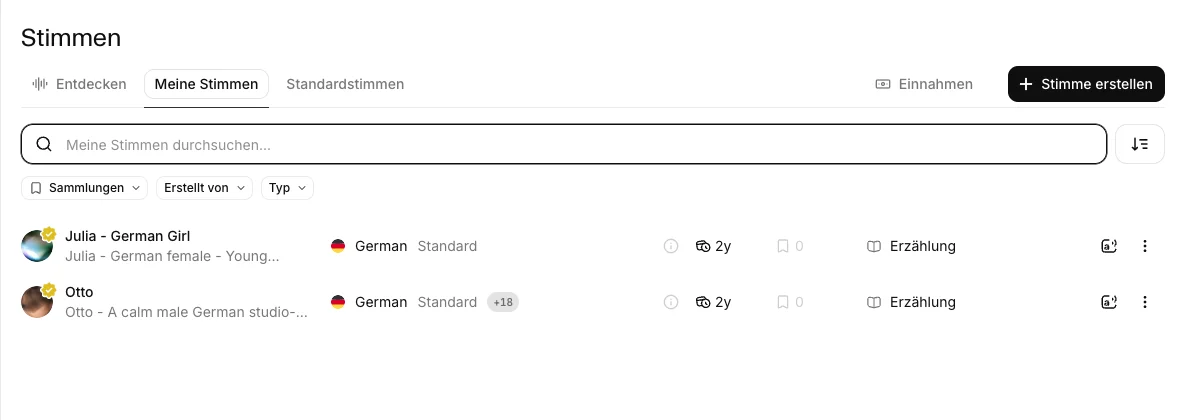
Voice cloning has changed quite a bit since I last took a close look. Under "Create voice," ElevenLabs now offers four routes: Voice Design (you describe a voice in text and get it in under a minute), Instant Voice Cloning, Professional Voice Cloning, and voice remixing.
The difference between Instant and Professional is the one that matters most for readers.
The Instant Voice Clone (IVC) needs only around 10 seconds of audio, and processing takes about 2 minutes afterward. It's included in the cheapest paid plan from $6 and is enough for plenty of quick projects. The Professional Voice Clone (PVC) needs a lot more, at least 30 minutes of clean recordings, and processing takes around 5 minutes. In exchange, the clone is then almost indistinguishable from the original. PVC only becomes available from the Creator plan at $22, and even there my account only gets exactly one reserved slot for it.
On the free plan, by the way, there's no voice cloning at all, neither Instant nor Professional. My Creator account shows a total of 0 of 30 voice slots used, that's the overall capacity for your own and cloned voices on this plan, separate from the one dedicated PVC slot.
Here's how the Instant Voice Clone works in practice: under the voices, you click "Create voice," upload around 10 seconds of audio (as a file or recorded straight in the browser, up to 10 MB), and about 2 minutes later you have your clone. One point ElevenLabs takes seriously, and you should too: you're only allowed to clone your own voice or one you have explicit consent for. Cloning someone else's voice without permission is banned.
5. Scribe: speech-to-text in 92 languages
ElevenLabs doesn't just turn text into voice, it works the other way too. The tool for that is called Scribe Realtime v2.
In its live banner, ElevenLabs bills Scribe as "lightning-fast transcription with unmatched accuracy in 92 languages" and calls it the "industry-leading ASR model." Big words, but I can confirm the language count: 92 languages are genuinely available.
For accuracy itself, you don't have to take my word for it. I already put ElevenLabs through my detailed comparison of AI transcription software, using the same test text against five other tools, recorded on an old MacBook's built-in microphone under deliberately imperfect conditions. That test file is still sitting in my Scribe account. If you want the exact percentages, you'll find them there.
What's practical for me is that I don't need a separate tool for transcription, I stay in the same account. If you transcribe a lot, though, it's worth looking at specialized providers like Sonix or Amberscript, which are built for exactly that job.
6. Music v2: the music generator
Since late May 2026, there's also a music generator called Music v2, currently the second model after an earlier version that's still visible in my generation history.
Here's the credit math again. Music v2 costs 900 credits per minute, per variant, and ElevenLabs automatically generates 2 variants per generation. That's 1,800 credits per minute of music. When I set the length to "Auto," the tool built itself a 3-minute track, which comes out to roughly 5,400 credits for a single generation.
For lyrics, you can choose between "Auto" (auto-lyrics) or your own text. ElevenLabs usually detects the genre automatically from your prompt, in my tests that meant hip-hop, electronic, and ambient. For downloads you get MP3, MP4, WAV, and an extended format.
Audio sample: 30 seconds from a lo-fi track I generated with Music v2
What impressed me most was the song editor. You work with a timeline of sections there, Intro, Verse, Bridge, and Outro. Each section has its own style tags and its own tempo, in my test for example "relaxed lo-fi hip-hop groove," "dusty snare," and 82 BPM. This is exactly where inpainting lives, you can regenerate a single section without touching the rest of the song, or give it a different genre entirely through new style tags.
Every such regeneration costs another 900 credits per minute and variant, so you use it deliberately rather than at random. I looked closely at the interface and the full workflow, and for a still-young music feature, it feels surprisingly polished.
I wrote up exactly how inpainting, genre switching, and the song editor work, plus how Music v2 stacks up against Suno, in a dedicated ElevenLabs Music guide.
7. Dubbing v2: automatic video translation
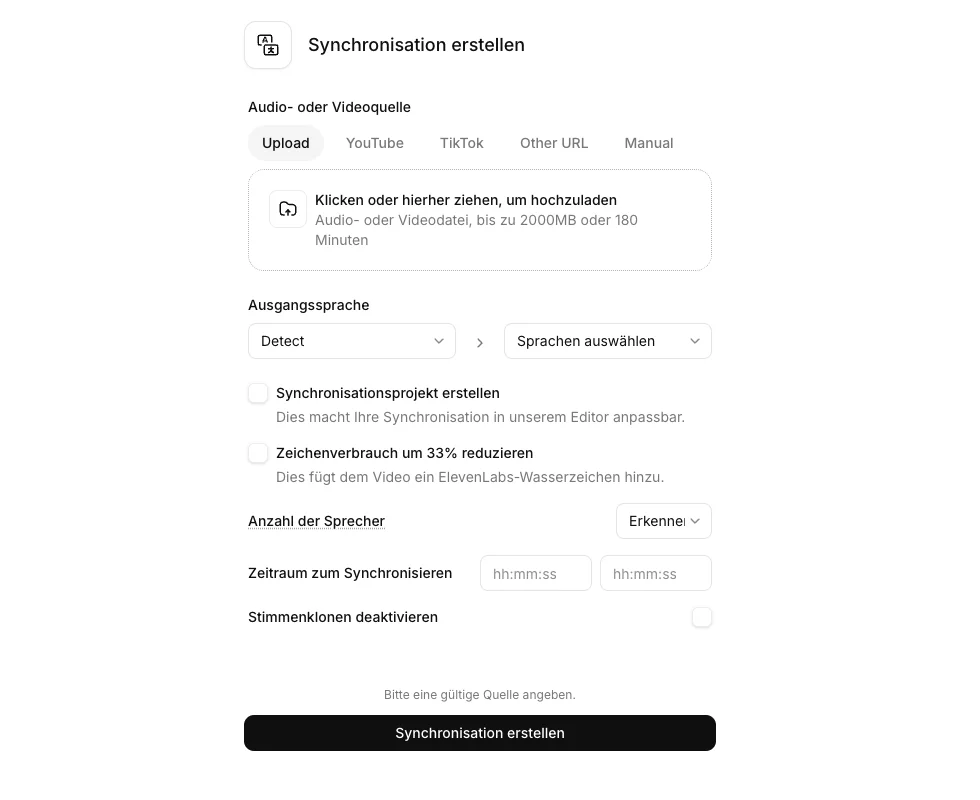
For video translation and dubbing, ElevenLabs has its own tool, currently labeled "Dubbing v2 (Alpha)."
In the intro modal, ElevenLabs makes three promises for Dubbing v2:
- The emotion and expression of the original speaker are preserved.
- The wording is adapted so the translation sounds natural in 92 languages.
- Voice cloning and syncing happen automatically.
On the upload screen, you either upload a file up to 10 MB or paste a URL directly. After that, you pick your target languages, and there's an "Advanced" section with additional settings.
From an earlier test, there's still a dubbing sample sitting in my account, an excerpt from Sebastian Fitzek's "Elternabend," though that one used the previous model, Dubbing v1. I read the "Alpha" label on v2 as ElevenLabs itself signaling that the feature isn't final yet. I'd currently treat it as something to test rather than something to trust for critical production work.
8. ElevenAgents: voice bots
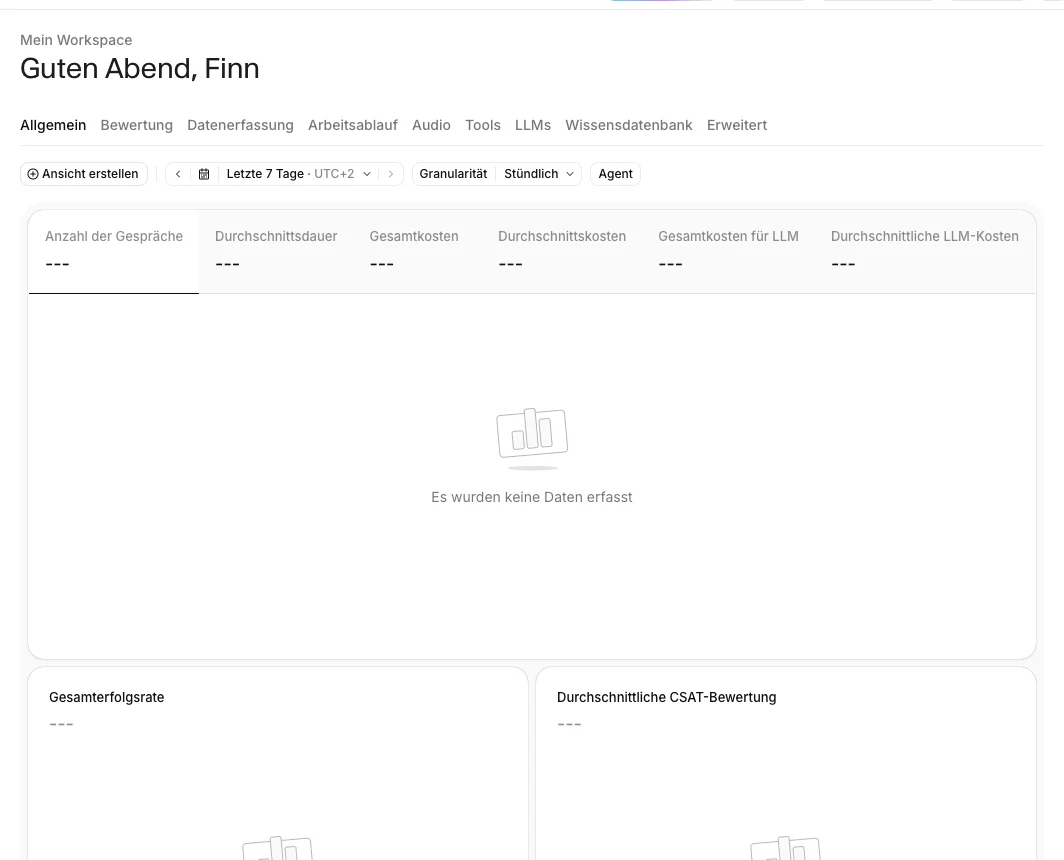
ElevenLabs also offers ElevenAgents, a builder for AI voice agents, bots that talk on the phone or in chat.
ElevenAgents is a big topic in its own right. I looked through the dashboard, and even there it's clear how extensive the builder is: phone numbers, WhatsApp, a knowledge base, tools, and the LLM configuration all live in one interface.
My take on it:
This is a full-fledged platform for voice agents. Judging it properly means building an agent and taking it live, and that goes beyond this hands-on review. A detailed test of it is coming in its own article.
9. The strengths, from my point of view
After this review, these are the points where ElevenLabs clearly comes out ahead for me:
- Quality and naturalness: This is the most important one. Eleven v3 sounds closer to a real person than anything else I've tested. With emotional or narrative scripts, the difference is obvious.
- Audio tags as a true differentiator: Writing [whispers] and [laughs] directly into the script and hearing exactly that in the result doesn't exist anywhere else like this. It's not just a nice extra, it's the reason ElevenLabs sits so far ahead for demanding voice projects.
- One platform instead of many subscriptions: Text-to-speech, Scribe, voice cloning, Music v2, dubbing, and ElevenAgents in one account. That's the underrated day-to-day advantage for me, because I don't have to juggle multiple tools and multiple invoices.
- Traceable credit billing: On Eleven v3, one character costs almost exactly one credit, and I verified that down to the exact digit in this test. No hidden rounding, no surprise on the invoice.
10. The weaknesses
No tool is perfect, and I wouldn't be doing my job if I only gushed. These are the points you should know about:
- No voice cloning on the free plan: You can use voices for free, but you can't clone your own. Instant Voice Cloning only starts at Starter, Professional Voice Cloning only at Creator.
- Music v2 on "Auto" eats credits fast: My 3-minute track cost around 5,400 credits, almost 4.5% of my entire Creator monthly allowance for one song. If you're testing, cap the length manually.
- The price can climb with heavy use: ElevenLabs bills by credits. As long as you voice things occasionally, the cheap plans cover you fine. But if you produce long scripts or full audiobooks daily, you burn through credits quickly and end up on the higher plans.
- Dubbing v2 is still alpha: ElevenLabs labels the feature that way itself. Fun for early testing, I'd be cautious for anything mission critical right now.
- USD billing plus VAT for EU buyers: The plans are listed in US dollars. As a buyer from the EU, you pay the listed USD price plus 19% VAT, so $22 for Creator becomes roughly $26 on the invoice.
- Higher latency with v3 for real time: Eleven v3 gives the best quality but takes a bit longer to generate. For pre-produced content that doesn't matter, but for a live voice bot, the latency is something you have to plan around.
- Most natural voice quality on the market (Eleven v3), especially for emotional scripts
- Audio tags like [whispers] and [laughs] for real emotion right inside the script
- Full audio platform: TTS, voice cloning, Scribe (92 languages), Music v2, dubbing, and ElevenAgents in one account
- Traceable credit billing, roughly 1 credit per character on v3
- Free plan to try it out, paid entry from $6/month
- Commercial license on every paid plan
11. Pricing and plans
ElevenLabs has a free version and several paid plans. Here are the most important ones at a glance, with the numbers from my own account and the pricing page.
Extra minutes beyond your allowance cost between $0.36 (Free) and $0.17 (Pro and Scale) per minute, the cheaper the plan, the pricier the extra minute gets. On Creator, the extra minute costs $0.18, and if you run out of credits there, you can top up with pay-as-you-go.
Studio projects also differ by plan: 20 on Starter, 1,000 on Creator, 3,000 on Pro, and 9,000 on Scale. For very large teams there's also a Business plan with roughly 6,000 free minutes a month, though I don't have verified pricing for it from my own account since it sits above my own plan.
Pay annually instead of monthly, and ElevenLabs gives you two months free, so you effectively pay for 10 months instead of 12. As an EU buyer, VAT at 19% always gets added on top, so the $22 Creator plan comes out to roughly $26 on the invoice.
For a more detailed breakdown of all seven plans, including the Business plan and the VAT math for EU buyers, check out my dedicated ElevenLabs pricing guide.
12. When ElevenLabs is worth it, and when it isn't
The short answer is that it depends. But I don't like leaving you with a non-answer like that, so here's my clear take.
12.1 Who ElevenLabs is worth it for
ElevenLabs is worth it for you if you use voice seriously and regularly. Concretely, that means:
- You produce voice-overs for YouTube videos or explainer films and want them to sound professional, with real emphasis instead of flat narration.
- You create audiobooks or narrate longer texts and need a voice that carries emotion.
- You run a podcast and want to produce intros, trailers, or full episodes with AI voices, or transcribe interviews with Scribe.
- You want to clone your own voice and reuse it again and again without re-recording every time.
- You publish in multiple languages and need clean voices across many languages from one place.
In all of these cases, the mix of quality, audio tags, and platform depth is worth the price.
12.2 Who would be fine with something cheaper
Don't get me wrong:
ElevenLabs is excellent, but not everyone needs that. A leaner, cheaper option is probably enough for you if:
- you only want to voice the occasional blog post for listening.
- a solid but not perfect voice is enough because it's purely informational.
- you mostly transcribe and barely generate speech, in which case specialized transcription tools are often the better choice.
- you're on a very tight budget and the USD price plus VAT weighs on you.
In those cases, it's worth a look at the ElevenLabs alternatives, where I go into cheaper and specialized tools in detail.
13. My final word
I went into this review as a skeptic and came out a user.
ElevenLabs won me over because it delivers exactly what I'd long missed in AI voices, namely naturalness, emotion, and a depth that goes beyond plain narration. The audio tags [whispers] and [laughs] are the feature that makes the difference for me, and the platform genuinely saves me time day to day because I no longer switch between multiple tools.
Is it the cheapest tool? No. Is it worth it for everyone? Also no, and with Music v2 you need to watch the length setting, or your balance disappears faster than you'd expect, I learned that on my own account. But for anyone who uses voice seriously, ElevenLabs is the first port of call right now. And you can try it for free before you spend a single cent.
If you want to test it yourself, you can head straight to ElevenLabs here and start with the free plan.