You want to know which AI writes the best text?
Then you have probably read a few comparisons in which every tool was "tested extensively." You almost never get to see a single one of the test texts.
I wanted to do that differently.
I gave eight current models from ChatGPT, Claude, Gemini, and Le Chat the same four writing tasks, three times each in English and three times in German. A script did the scoring, and it only counts things such as length, the facts carried over, and banned words.
In this article, I show you which AI follows your instructions most precisely, when the free version is enough, and who still benefits from a specialized AI text generator like Neuroflash or Jasper.
- For everyday texts such as emails, product descriptions, or blog intros, you do not need a specialized tool. In the writing test, all eight models from ChatGPT, Claude, Gemini, and Le Chat carried over every given fact and invented no numbers.
- On the English tasks, seven of the eight models met every requirement in 12 of 12 runs, including the free ones. Mistral Medium 3.5 managed 9 of 12.
- German was harder. Claude and Gemini stayed at 12 of 12, while both ChatGPT models dropped to 9 of 12 because their texts came out too short.
- Specialized AI text generators like Neuroflash or Jasper only pay off when a team works with templates, a brand voice, or fixed SEO workflows.
1. Which AI Writes the Best Text?
For the vast majority of texts, you no longer need a specialized tool. A chatbot with a clear brief is enough.
In my test, all eight models carried over the given facts completely. Across 192 answers, there was not a single invented number.
There were still differences:
- ChatGPT, Claude, and Gemini: All seven models met every requirement in all 12 English runs. That includes the free models GPT-5.6 Luna, Claude Sonnet 5.5, and Gemini 3.6 Flash.
- Le Chat: Mistral's model answered by far the fastest but missed the length requirement in 3 of 12 English runs.
- German: Claude and Gemini kept a clean sheet there too, while ChatGPT came in too short on the product descriptions.
If you write in English, pick the chatbot you already use. The test gives you no reason to switch.
If you also write in German and exact specifications matter to you, I would go with Claude or Gemini. You can use both for free.
2. The Writing Test: 8 Models, 4 Tasks, 192 Texts
I tested the models you actually get in the free versions and in the plans around $20 per month. For ChatGPT, those are GPT-5.6 Luna and GPT-6 Sol, and for Claude, Sonnet 5.5 and Opus 5.5.
Gemini adds Gemini 3.6 Flash, Gemini 4 Hydrogen, and Gemini 4 Argon, and Le Chat runs on Mistral Medium 3.5.
2.1 How the Test Worked
Every model received the same four tasks:
- Blog intro: 120 to 150 words for a bike shop's blog, with three permitted facts.
- Product description: 80 to 100 words about a water bottle, with no superlatives, no exclamation marks, and six mandatory details.
- Business email: A formal meeting cancellation with two alternative dates and at most 110 words.
- Rewriting: A paragraph of officialese turned into plain English without losing or adding a detail.
Each task ran three times per model in English and three times in German. The requests went to the models through the API on November 15, 2026, with no system prompt and with default settings.
No human and no second AI did the judging. A script counted the following for each text:
- Is the word count within the required range?
- Does the text contain all mandatory details?
- Does the text contain a number that was not in the brief?
- Do banned words or characters appear?
- Is there a preamble before the text or a follow-up question after it?
2.2 The Results in English
The table shows in how many of the 12 English runs a model met all requirements at once:

- App and plan
- ChatGPT, Free
- All requirements met
- 12 of 12
- Response time (median)
- 3.4 s
- API cost per text
- 0.05 cents
- App and plan
- ChatGPT, Paid plan
- All requirements met
- 12 of 12
- Response time (median)
- 4.3 s
- API cost per text
- 0.36 cents

- App and plan
- Claude, Free
- All requirements met
- 12 of 12
- Response time (median)
- 4.9 s
- API cost per text
- 0.95 cents

- App and plan
- Gemini, Paid plan
- All requirements met
- 12 of 12
- Response time (median)
- 5.7 s
- API cost per text
- 0.54 cents
- App and plan
- Claude, Paid plan
- All requirements met
- 12 of 12
- Response time (median)
- 8.2 s
- API cost per text
- 2.29 cents
- App and plan
- Gemini, Free
- All requirements met
- 12 of 12
- Response time (median)
- 10.3 s
- API cost per text
- 0.99 cents
- App and plan
- Gemini, Free (automatic routing)
- All requirements met
- 12 of 12
- Response time (median)
- 20.3 s
- API cost per text
- 2.51 cents

- App and plan
- Le Chat, Free
- All requirements met
- 9 of 12
- Response time (median)
- 1.3 s
- API cost per text
- 0.12 cents
 gradually.ai
Seven models score 12 of 12, and you can use four of them for free. The more expensive model of a provider never followed the brief more precisely than the free one.
Mistral Medium 3.5 leads on speed. Its answer arrived after a median of 1.3 seconds, while Gemini 4 Hydrogen needed a good 20 seconds.
You can ignore the cost for individual texts. Even the most expensive model in the test cost an average of only 2.51 cents per text through the API.
The German results were less even. Claude and Gemini met all requirements in 12 of 12 runs, GPT-6 Sol and GPT-5.6 Luna in 9 of 12, and Mistral Medium 3.5 in 6 of 12.
2.3 Where the Models Missed
Every violation in the test had the same cause.
The texts were too short.
Mistral Medium 3.5 delivered two English blog intros with 115 and 116 words when at least 120 were required. In German, GPT-6 Sol handed in the product description with 77 or 78 words in all three runs, against a minimum of 80.
Whether two missing words bother you depends on the text. For a meta description or an ad with a character limit, that is exactly what counts.
The script found no missing fact, no invented number, and no banned word from any model.
2.4 Three Product Descriptions Compared
Numbers say nothing about how a text reads. That is why you will find three answers to the same task here, word for word, each from the first run.
Claude Opus 5.5 wrote 98 words:
The Northlight 750 goes wherever your day takes you. With a capacity of 750 ml, it holds enough water, coffee or tea to keep you going through meetings, hikes or commutes. Its double-walled stainless steel construction keeps your drinks hot for 12 hours and cold for 24 hours, so your morning tea stays warm and your afternoon water stays cool. At 320 g, it slips easily into your bag without weighing you down. To keep it in good condition, wash it by hand, as it is not dishwasher safe. You can make the Northlight 750 yours for $34.90.
GPT-6 Sol came to 90 words:
Take your drink with you in the Northlight 750 water bottle. Its 750 ml capacity gives you room for a drink throughout your day, while double-walled stainless steel keeps it hot for 12 hours or cold for 24 hours. The bottle weighs 320 g, so you can account for it when deciding what to carry. You can use it for a hot drink on one day and a cold drink on another. The Northlight 750 costs $34.90. It is not dishwasher safe, so you should wash it by hand only.
Mistral Medium 3.5 used 86 words:
The Northlight 750 is a 750 ml double-walled stainless steel water bottle that keeps your drinks hot for 12 hours or cold for 24 hours. Weighing just 320 g, it’s designed for daily use, whether you're at work, outdoors, or on the go. Its durable construction ensures long-lasting performance, while the insulation maintains your preferred temperature. To preserve its quality, this bottle should be hand washed only. Priced at $34.90, it offers a reliable way to enjoy your beverages at the right temperature throughout the day.
The brief explicitly forbade inventing further features. GPT-6 Sol followed that most strictly, but it sounds wooden in places.
Mistral Medium 3.5 credited the bottle with a "durable construction" and "long-lasting performance." Neither was in the brief. Claude Opus 5.5 also added a judgment when it wrote that the bottle "slips easily into your bag."
My script only counts numbers, so it does not catch additions like these. Always read an AI text against your source before you publish it.
2.5 What the Test Does Not Show
The test covers short texts with given facts. It does not tell you which model writes the best 2,000-word blog article or researches most cleanly.
Three runs per task are also a small sample. A gap of 12 to 9 runs shows a tendency and no final verdict.
The hallucination rates further down show how reliable the models are with facts when there is no source to copy from.
3. AI Text Generators for Teams: When a Specialized Tool Pays Off
Specialized AI text generators mostly run on the same models as the chatbots today. In Neuroflash's chat, for example, you switch between GPT, Gemini, Claude, and Mistral.
So what you pay for there is mainly brand voice, team features, and SEO workflows.
The following four tools were not part of my writing test. All details come from the providers' pricing and product pages. Where a provider states nothing, the table says "n/a."




- Price
- from €42 / month
- Brand voice
- Yes
- Team features
- Yes
- SEO features
- Yes
- Free to try
- Free trial
Details
- Price:
- Germany, annual billing, plus VAT
- Brand voice:
- Brand Voice Creator
- Team features:
- invite users, roles
- SEO features:
- SEO research in chat
- Free to try:
- 7 days
- Price
- $79 / month
- Brand voice
- Yes
- Team features
- Partial
- SEO features
- Yes
- Free to try
- Free trial
Details
- Price:
- Starter, annual billing
- Brand voice:
- 1 writing style on Starter
- Team features:
- Starter: 1 user
- SEO features:
- audits, Search Console
- Free to try:
- no credit card
- Price
- from $59 / month
- Brand voice
- Yes
- Team features
- Partial
- SEO features
- n/a
- Free to try
- Free trial
Details
- Price:
- Pro, annual
- Brand voice:
- 2 on Pro
- Team features:
- Pro: 1 seat
- Free to try:
- 7 days
- Price
- from $9 / month
- Brand voice
- n/a
- Team features
- n/a
- SEO features
- n/a
- Free to try
- Free plan
Details
- Price:
- Lite, monthly
- Free to try:
- 10,000 characters/month
3.1 Neuroflash

Neuroflash is a German provider built for German-speaking teams. The interface and support are available in German, along with templates you will not find in other tools, such as switching between formal and informal address.
According to the provider, your stored data is kept on servers in Germany. Its privacy statement says AI queries are also processed in the EU and the US. Neuroflash is certified to ISO/IEC 27001:2022 and does not use your content to train the models.
The Neuroflash pricing page lists two fixed plans. Essential costs €42 per month with annual billing, plus VAT. Pro costs €84 per user per month with annual billing, also plus VAT.
Neuroflash is a very good choice if your company only approves AI writing with a German provider and clear data protection commitments.
3.2 Writesonic
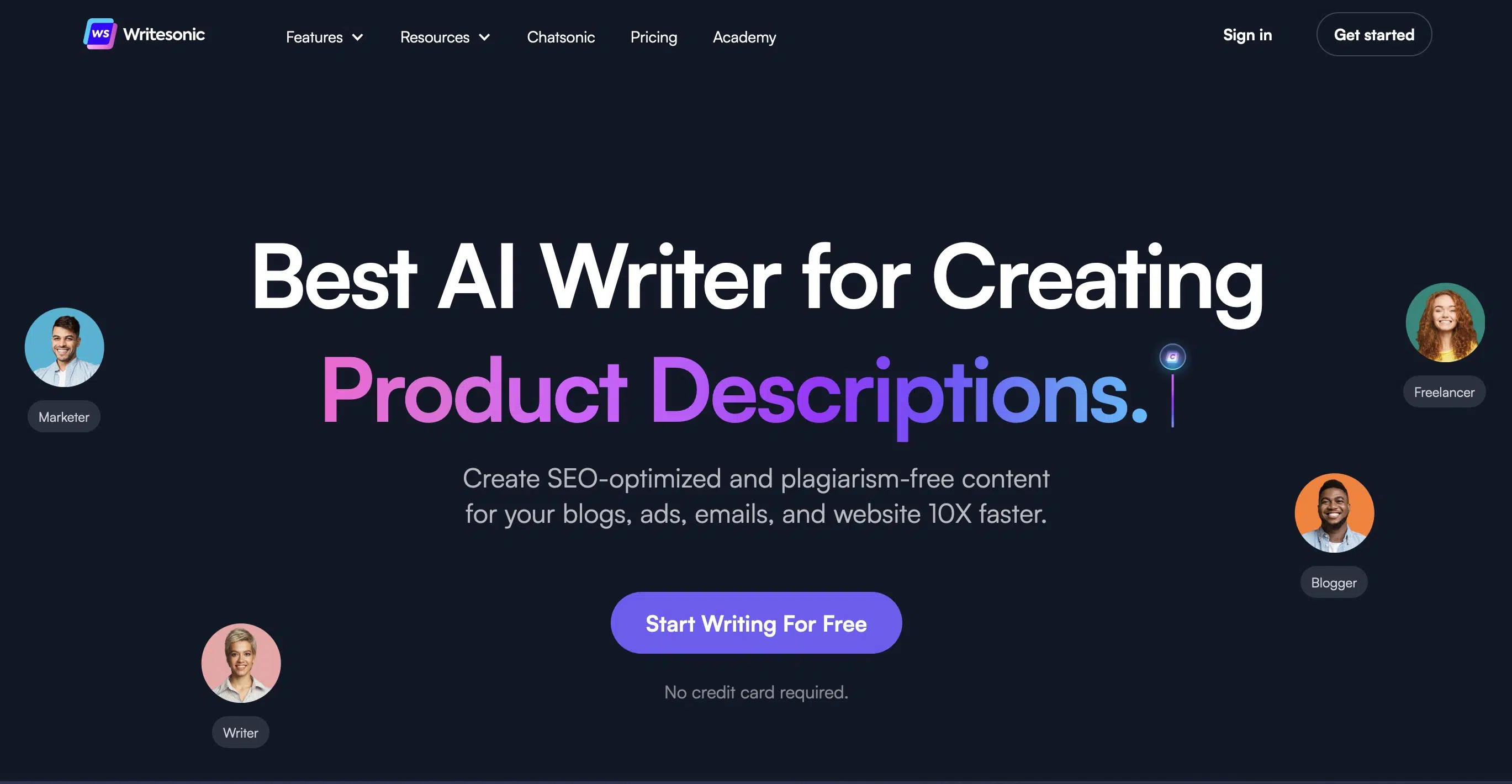
Writesonic has grown from a text generator into a platform for visibility in AI search. The writing features still exist, but they are no longer the focus.
According to the pricing page, the Starter plan costs $79 per month with annual billing. That includes 15 AI articles, 10 site audits per month, one writing style for your brand, and one user.
A highlight of Writesonic is the integrated AI chatbot Chatsonic, which sits alongside integrations for Google Search Console and WordPress. That makes Writesonic a fit if you regularly plan, write, and publish SEO articles in one place.
For individual texts, the price is too high. You get those for less in any of the chatbots I tested.
3.3 Jasper
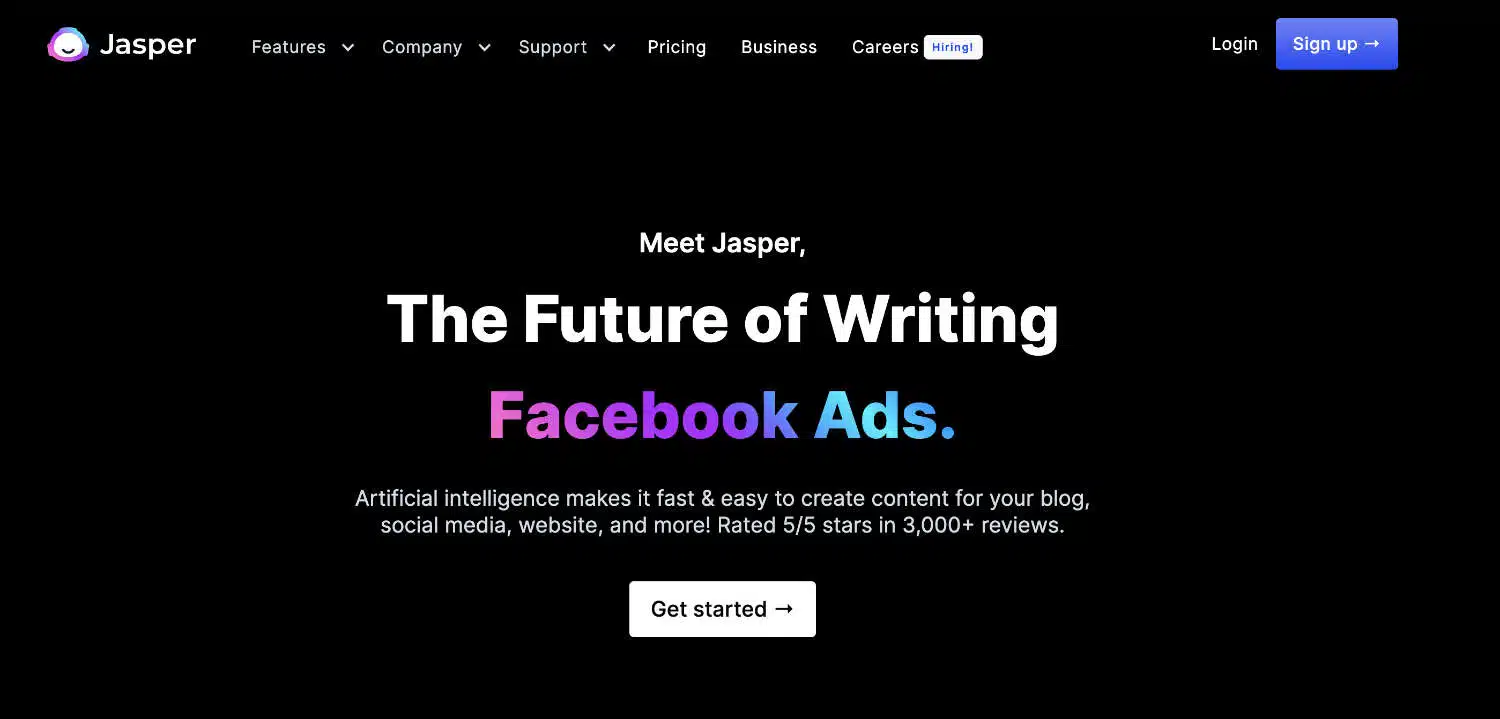
Jasper is one of the oldest AI text generators and now clearly targets marketing teams. According to the provider, you work with more than 100 marketing agents for different types of text.
The Pro plan costs $59 per month with annual billing or $69 billed monthly. It includes two brand voices and one seat. You can try Jasper free for seven days.
Jasper plugs into your existing tools through its API, MCP, and a browser extension.
Jasper pays off when several people need to write in the same brand voice. For that you need the Business plan, though, because only there do several users work together. Jasper quotes its price on request only.
3.4 Rytr
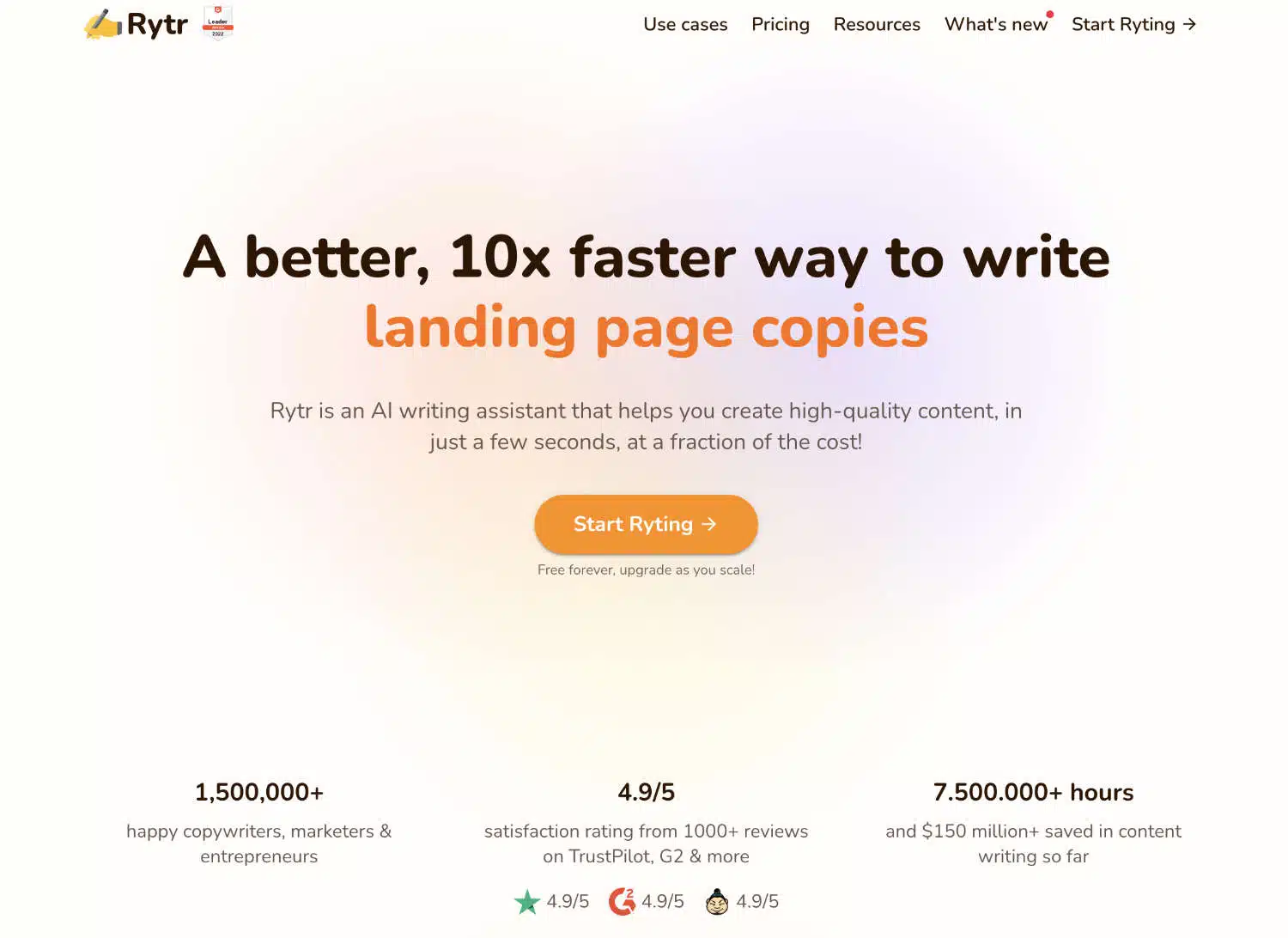
Rytr is the cheapest entry point among the specialized tools. The free plan includes 10,000 characters per month, and the Lite plan costs $9 per month.
On its homepage, Rytr now promotes an AI assistant for customer relationships. The text generator lives on as the product "Create," with more than 40 use cases and over 30 languages.
That said:
You also get permanent free access with ChatGPT, Claude, Gemini, and Le Chat. Rytr can work if you like fixed templates for short texts. I no longer see a compelling reason for it.
4. Writing AI Text for Free: Is the Free Version Enough?
Yes, for everyday texts it is.
The free version of ChatGPT runs on GPT-5.6 Luna, Claude's on Sonnet 5.5, and Gemini's on Gemini 3.6 Flash. All three models met every requirement in English in the test and matched the models from the paid plans.
Le Chat uses Mistral Medium 3.5 in its free version.
A subscription at around $20 per month mainly gives you higher usage limits and extra features. According to my test, it does not get you more precise everyday texts.
My AI chatbot comparison shows which app fits you. If you just need a short text quickly, you can also use Gradually's free AI text generator.
5. How well do the models behind ChatGPT, Gemini and Claude write?
The writing test above covers four short tasks. The overall index combines many independent benchmarks and shows how strong the models are overall.
The gradually.ai overall index combines independent benchmarks into one value. Among the 48 ranked OpenAI, Google and Anthropic language models, Claude Fable 5.2 (130.3 points), Gemini 4 Carbon (127.8 points) and Gemini 4 Neon (127.1 points) lead.
OpenAI's strongest model is GPT-6.2 Astra at rank 4 of 99 (126.6 points). Google's strongest model is Gemini 4 Carbon at rank 2 of 99 (127.8 points). Anthropic's strongest model is Claude Fable 5.2 at rank 1 of 99 (130.3 points). 100 points is the average of a fixed reference group; 15 points more means a model wins about three of four benchmark comparisons. The median of all 99 ranked language models is 88.8 points.
Overall index (Gradually Meta-Score v6)
20 of 48 models
6. Which model makes up facts the least when writing?
If you generate blog posts or product copy, you have to track down every invented figure yourself later. A low rate saves you checking work.
Artificial Analysis uses AA-Omniscience to measure how often a model guesses wrong on knowledge questions instead of admitting it does not know. Each model counts with its best measured setting.
Among the 27 measured OpenAI, Google and Anthropic models, Gemini 4 Carbon (4%), Gemini 4 Argon (4%) and Gemini 4 Neon (14%) hallucinate least.
OpenAI's most reliable model is GPT-6.1 Terra at rank 30 of 77 (35%). Google's most reliable model is Gemini 4 Carbon at rank 1 of 77 (4%). Anthropic's most reliable model is Claude Haiku 4.5 at rank 13 of 77 (23%). The median of all 77 measured models is 39%.
Hallucination rate
Share of wrong answers among all answers that are not correct, lower is better. Best measured setting per model.
20 of 27 models
Measured by Artificial Analysis (AA-Omniscience)
7. What does text cost through the API with ChatGPT, Gemini and Claude?
The text generators above charge fixed monthly prices. With direct access to the models you pay per token instead, and long texts cost correspondingly more.
Among the 34 current OpenAI, Google and Anthropic language models with an API price, Claude Haiku 5.5 ($0.20), GPT-6 Luna ($0.20) and Gemma 4 31B ($0.21) are the cheapest. All values are blended prices per 1M tokens of three parts input to one part output, as in the LLM price index.
OpenAI's cheapest current model is GPT-6 Luna at rank 8 of 106 ($0.20). Google's cheapest current model is Gemma 4 31B at rank 12 of 106 ($0.21). Anthropic's cheapest current model is Claude Haiku 5.5 at rank 8 of 106 ($0.20). The median of all 106 priced language models is $1.53.
API prices
Blended price in US dollars per 1M tokens, 3 parts input to 1 part output
20 of 34 models
Source: gradually.ai LLM price index
8. Conclusion
For most people, the best AI text generator is a chatbot that costs nothing.
In English, ChatGPT, Claude, and Gemini all delivered reliably in my test. In German, Claude and Gemini stayed precise, while ChatGPT and Le Chat needed a second round more often when a length was specified.
A specialized AI text generator only pays for itself in a team. Neuroflash suits German companies with data protection requirements, Jasper suits marketing teams with a fixed brand voice, and Writesonic suits anyone who publishes SEO articles in series.
And whichever tool you choose, read every text against your source before it goes live.
Frequently Asked Questions About AI Text Generators
They deliver drafts and variations quickly for recurring writing tasks. Time and cost savings depend on research, fact-checking, and editing:
- Drafts: Ask for a first version or several alternatives.
- Recurring tasks: Some tools let you reuse templates and repeatable steps.
- Customization: Describe the audience, format, and tone in your prompt.
There is no single format list for all AI text generators. ChatGPT Deep Research currently lets you download completed reports as Markdown, Word documents, or PDF. Import, export, and WordPress integrations vary by product and plan.