You've created some great images with Midjourney. Now you want to use them on your website, sell them on a print-on-demand shop, or put them in a client presentation.
But wait. What are you actually allowed to do with these images? Who owns them? And could you accidentally step on someone's copyright?
I dug into the legal side of things so you don't have to. Here's what I found.
- AI images are not protected by copyright - they don't qualify as 'personal intellectual creation' and can be freely used
- According to Midjourney Terms, you own your created images, but others can also freely use them (no exclusive protection)
- Beware of copyright infringement: Don't use Disney characters, brand logos, or protected figures - not even AI-generated ones
1. Are AI Images Protected by Copyright?
Big question, clear answer: No.
According to U.S. Copyright law and similar laws in most countries, the work must be created by a human to receive copyright protection:
Copyright protects only works that are the result of human authorship.
Tools and aids are allowed, such as a camera or graphics software. AI image generators like Midjourney, however, are not considered mere tools, since although you enter your own prompts, the result is random.
And because the result is not predictable and replicable, the work is not a personal (human) intellectual creation and therefore not protected by copyright.
The good news: you can use AI images freely and without conditions.
The catch:
You have no exclusive image rights with Midjourney. Anyone else can also freely use the AI images you've generated since they are not protected.
2. Midjourney License Terms
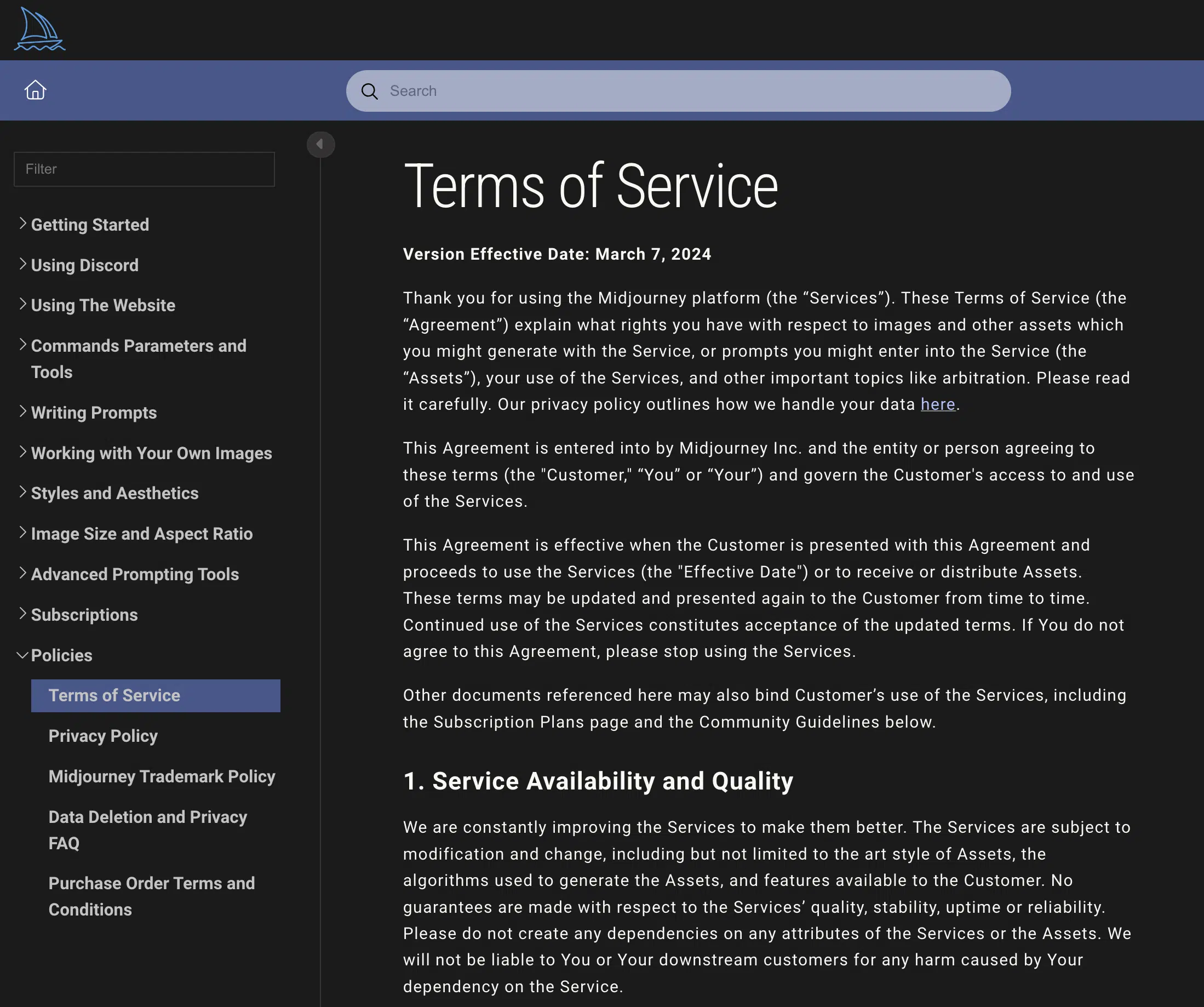
Midjourney also has its own license terms, which can be found in the Terms of Service. Currently, these provide the following:
Images created with Midjourney belong to the person who created them. So you can freely use and utilize these images without mentioning Midjourney.
However, this does not apply if...
- you work in a company that generates more than one million US dollars in revenue per year. In this case, a Pro or Mega subscription must be purchased
- you upscale images from others (these belong to whoever created the original image)
- your images violate the rights of others or Midjourney's terms of use
3. Copyright Issues with AI Images
A completely different issue is the question of copyright infringement with AI images. Here you should be careful as a user.
Major media companies are increasingly taking legal action against AI image generators. This shows how important careful handling of copyrighted material is.
Because an AI doesn't distinguish between images that violate copyright and those that don't, it generates everything you want.
Just because you can easily create images of Disney princesses with Midjourney doesn't mean you should use them.
Because such and similar characters are protected by copyright, and this protection also applies to images that were AI-generated but are very similar to the protected characters.
Before you distribute products that contain or feature AI-generated images, logos, symbols, or characters, you should definitely check whether they might violate existing copyrights.
This is the case, for example, with famous characters like:
- SpongeBob SquarePants
- Shrek
- Captain America
- Care Bears
- Tom & Jerry
- Pikachu
- Donald Duck
- Mickey Mouse
- etc.
4. Can Midjourney Simply Use Images from the Internet as Training Data?
In the American legal system, the fair use principle applies, which can be found in Section 107 of the U.S. Copyright Act.
The law explicitly mentions criticism, commentary, news reporting, teaching, scholarship, and research as examples of possible use of copyrighted works without the rights holder's consent.
It is viewed particularly favorably when the original work is used in a new, transformative way.
Whether the use of copyrighted texts and images by technology companies like OpenAI, Midjourney, Google, etc. happens in a "transformative way" is not conclusively clarified and is currently the subject of many discussions and lawsuits.
In the European Union, the legal situation is somewhat clearer. The use of texts and images from the internet for text and data mining purposes is generally permitted under the EU Copyright Directive:
Text and data mining means any automated analytical technique aimed at analysing text and data in digital form in order to generate information which includes but is not limited to patterns, trends and correlations.
Reproductions and extractions of lawfully accessible works for the purposes of text and data mining shall be permitted.
However, rights holders may reserve their rights by expressing this in a machine-readable format for online content.
Rights holders have the option to declare a reservation of use and exclude their works from mining.