GPT-3.5 or GPT-4? This was one of the most common questions around ChatGPT for a long time.
Both models have since been superseded by newer generations. The comparison remains useful because it makes the differences between those generations clear.
The short version: GPT-4 was more capable on complex tasks. GPT-3.5 was often faster and cheaper. For new projects, assess current models. For existing applications, this historical context can help with migration decisions.
1. What is GPT-3.5?
GPT-3.5 is a model family from OpenAI and an evolution of GPT-3. ChatGPT launched on November 30, 2022 using a model from that series, whose training OpenAI says was completed in early 2022.
GPT-3.5 was the default model of ChatGPT for a long time, available even to free users. OpenAI later replaced it with newer models. For an overview of current options, see the comparison of ChatGPT alternatives.
It was well suited to routine text work that was everyday and not particularly demanding:
- Formatting HTML tables and blog articles
- Switching between formal and informal tone
- Quick brainstorming and translations
- Changing capitalization
- Tables of contents and smaller code snippets
On comparable tasks, GPT-3.5 was often faster than the original GPT-4.
2. What is GPT-4?
GPT-4 was ChatGPT's flagship language model until 2024. It became available in mid-March 2023 and was later superseded by newer model generations.
GPT-4 was more capable than GPT-3.5 on complex tasks. Exact performance still depended on the model variant and use case.
GPT-4 was especially strong in these tasks:
- Math and logic
- Data categorization
- Programming
- Text comprehension and complex instructions
In ChatGPT, model selection was combined with tools such as DALL·E, browsing, and Advanced Data Analysis. Their availability depended on the plan and the current rollout. The ChatGPT plugins of that era could connect third-party services and data.
GPT-4 could be slower and could still make mistakes. Usage limits also varied by demand and plan. Those historical product limits do not explain current availability.
Historical context
3. GPT-3.5 and GPT-4 compared
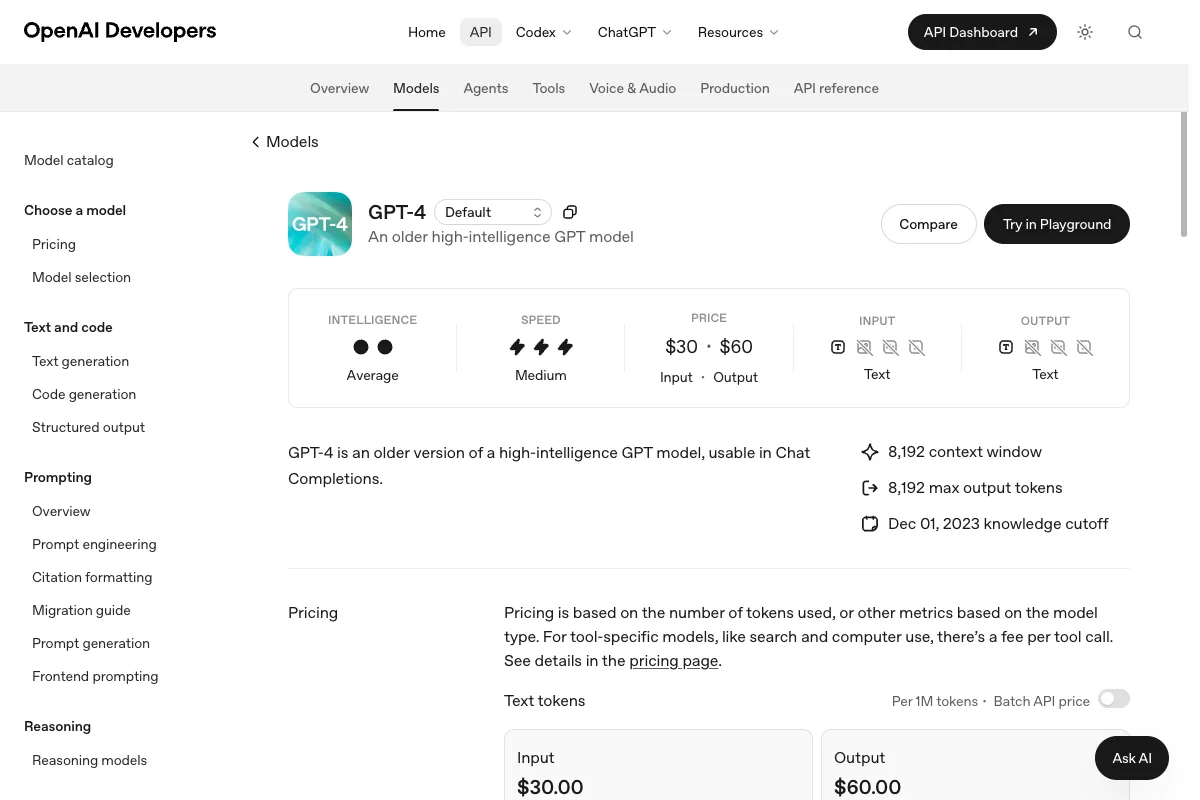
The table places GPT-3.5 alongside the historical base GPT-4 model. Context windows and availability could differ across later variants and API snapshots.
Frequently asked questions about GPT-3.5 vs. GPT-4
API prices and availability varied by model version and changed over time. Before a new implementation, check the prices of currently supported models in the LLM Price Index. ChatGPT subscriptions had separate pricing.
The answer depends on the GPT-4 variant and whether you mean the API or ChatGPT:
- Image inputs: GPT-4 with Vision could analyze and describe images.
- Context window: Its size varied by model variant. GPT-4 Turbo had a larger context window than the original GPT-4.
- Function calling: The June 2023 API updates introduced function calls with structured arguments for both GPT-4 and GPT-3.5 Turbo. This was not an exclusive GPT-4 advantage.
- JSON mode: GPT-4 Turbo and the updated GPT-3.5 Turbo version received a mode for valid JSON output in November 2023.
- Custom Instructions: This is a ChatGPT feature, not an exclusive capability of the GPT-4 API model.
GPT-4 and its variants expanded text generation with additional inputs, outputs, and developer features.