900 million people use ChatGPT every week. Meta AI counts around one billion monthly users, Gemini 950 million. Reading numbers like these, you might think AI is everywhere by now.
It is not.
Around 71% of humanity has never knowingly used generative AI. And the group using AI coding agents like Claude Code is so small it almost disappears in a chart of the world population.
That chart is right below. After it, I will show you where the numbers come from, how many people actually pay for AI, and what all of this means for you.
- Around 2.4 billion people, 29% of the world, actively use generative AI. About 5.9 billion, 71% of humanity, never have, per DataReportal (April 2026).
- Only around 80 million people worldwide pay for an AI subscription, roughly 1% of humanity. OpenAI alone officially reports 50 million paid consumer subscriptions (February 2026).
- The tip of the pyramid is tiny: this article's editorial, deduplicated estimate is 25 to 35 million regular users of AI coding agents like Claude Code or Codex. The chart uses the midpoint of 30 million, around 0.36% of humanity.
1. All of Humanity in One Chart
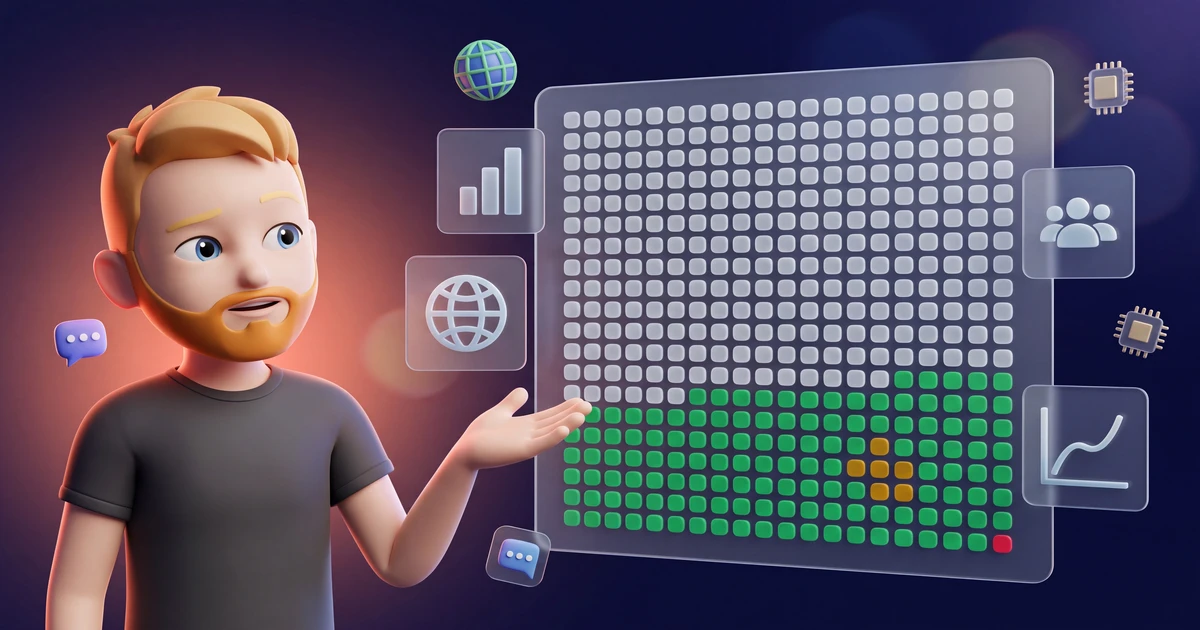
Each dot in this chart stands for roughly 3.3 million people. All 2,500 dots together make up the world population of about 8.3 billion. The color shows the most advanced way a person uses AI:

The four groups are deliberately exclusive. Every person counts only in their most advanced category: if you pay for ChatGPT Plus, you do not also show up among the free users.
What surprised me most about this chart is not all the gray. It is the ratio between the colored areas.
Of 2.4 billion AI users, only about one in thirty pays for a subscription. And of those paying users, only a fraction uses AI agents that complete tasks on their own. The red area, nine dots out of 2,500, is where the biggest productivity gains are happening right now.
2. How Many People Use AI Chatbots?
The answer is that nobody knows exactly. What exists are the figures from individual providers:
Whatever you do, do not add these numbers up. Anyone using ChatGPT, Gemini, and Meta AI in parallel appears three times. The gross sum of the large providers comes to just under 4 billion accounts, far more than the actual number of people behind them.
The best deduplicated estimate comes from DataReportal and We Are Social:
2.42 billion people actively used generative AI platforms in April 2026, which is 29.2% of the world population. That number more than doubled within twelve months, with around 1.4 billion people joining.
And yes: this figure carries uncertainty too, since DataReportal does not fully disclose its methodology. But it is the only global net figure that exists, and it lines up with the national studies in the next section.
You can find more detail on the individual services in our ChatGPT statistics and the general AI statistics.
3. AI Adoption by Country
The global average of 29% hides enormous differences. Here are the key reference points from representative studies:
The Eurostat bars are directly comparable with each other (generative AI in the last 3 months, ages 16-74). The Bitkom and Pew bars measure more broadly, which is why they carry their own labels.
The double Germany bar is especially revealing. According to Bitkom (any kind of AI use), Germany sits at 58%. In the stricter Eurostat measurement, it is only 32.2%, just below the EU average of 32.7%. Methodology massively decides what the headline looks like.
Two patterns run through every study:
First, age. In the EU, 64% of 16- to 24-year-olds use generative AI, but only 7% of 65- to 74-year-olds (Eurostat, 2025). Second, wealth: richer countries like Norway sit far ahead, poorer ones like Romania trail far behind, and you can see the exact numbers in the chart above.
However: usage is not the same as routine. According to Pew Research, 49% of US adults have used AI chatbots (surveyed February 2026), but for most it stays occasional. Only 10% of people worldwide use AI chatbots weekly for news (Reuters Institute, 2026).
4. How Many People Pay for AI?
This is where the pyramid gets narrow. Of 2.4 billion users, only a small share pays for a subscription:
The only hard official figures come from OpenAI: 50 million paid consumer subscriptions plus more than 9 million paying business users (both February 2026). Anthropic and Google say nothing about their subscriber counts. All we know is that Claude's paid subscriptions more than doubled within a few months in early 2026.
For Perplexity, numbers around 18 million paid subscriptions circulate online. They cannot be right: at $20 per month, that would be over $4 billion in annual revenue, while Perplexity itself reports only around half a billion. I deliberately leave aggregator numbers like that out.
Adding it up conservatively (OpenAI alone accounts for 59 million, plus the undisclosed paying users at Anthropic, Google, Perplexity, and Microsoft), we land at 70 to 100 million paying AI subscribers worldwide. For the chart above, I used 80 million.

For perspective: that is about 1% of humanity and roughly 3% of active AI users. Netflix alone has more than three times as many paying accounts as the entire AI subscription market. One caveat on that figure: the 325 million is a milestone mentioned in the Q4 2025 shareholder letter, since Netflix stopped publishing regular subscriber counts in early 2025.
I broke down what the subscriptions cost in our ChatGPT statistics and Claude statistics.
5. The Tip of the Pyramid: AI Coding Agents
At the very top of the pyramid sit the people who do not just ask AI questions but let it work on its own. AI coding agents write code, run it, test it, and correct themselves:


These numbers are harder to pin down than the chatbot figures. The groups overlap heavily, the metrics are not directly comparable, Anthropic does not disclose an absolute user count for Claude Code, and a large share of Copilot subscriptions sits in classic autocomplete rather than real agent work.
On August 21, 2026, OpenAI employee Tibo Sottiaux wrote that Codex had passed the milestone of 20 million active users sometime during that week. The figure does not define a weekly or monthly activity window, so it cannot be labeled as WAU or MAU. OpenAI's official June 2 announcement instead reports more than 5 million weekly active Codex users. The two figures use different measurements and do not form a continuous series.
The 20 million milestone strongly suggests that the previous estimate of 10 to 15 million understated the scale. I therefore use a conservative, deduplicated editorial estimate of 25 to 35 million regular AI coding-agent users worldwide. The chart uses the midpoint of 30 million. That is around 0.36% of humanity, or nine out of 2,500 dots. This is not a provider figure. It accounts for tool overlap and deliberately leaves Claude Code without an invented absolute count.
Do not get me wrong: this small red corner is no niche curiosity. OpenAI reports that Codex usage is growing three times faster among knowledge workers than among traditional developers. Anthropic reports that Claude Code weekly active users have doubled since January 1, 2026 and business subscriptions have quadrupled. GitHub Copilot has 4.7 million paid subscriptions, up 75% year over year. The red area will visibly grow over the next few years.
If you want the full picture on these tools, check the Claude Code statistics and Codex statistics.
6. The Blind Spot: 2.2 Billion People Are Offline
One detail often gets lost in AI debates. According to the ITU, 2.2 billion people were still completely offline at the end of 2025, around 27% of the world population.
These people cannot use generative AI at all, no matter how good the models get. More than a third of the gray area in the chart above is not about interest or skepticism. It is about missing internet access.
That also puts the hype line about AI being the fastest adopted technology in history into perspective. It is spreading at breathtaking speed, but almost exclusively within the connected half of the world.
7. What Does This Mean for You?
I have been looking at AI numbers almost daily since early 2022, but this chart changed my perspective.
In my work bubble, seemingly everyone uses AI. My newsletter readers use AI, my clients use AI, everyone on LinkedIn talks about agents. The chart shows how small that bubble really is.
The good news: if you sometimes feel like you are too late, you are almost certainly wrong. Anyone working with AI regularly today belongs to the first 29% of the world. Anyone paying for AI belongs to the first 1%. And anyone working with AI agents is part of a small group spread across the entire planet.
The fact is: the curve points steeply upward. 1.4 billion new AI users in a single year is an adoption speed the world has never seen. The chart in this article will look much greener in twelve months. But today, in August 2026, AI competence is still a real head start, not table stakes.
If you want to use that head start, our overview of the best AI tools is a good place to start.