
Claude is one of the most popular AI chatbots and one of the best ChatGPT alternatives currently available. And for good reason:
It can perform many tasks just as well or better than OpenAI's flagship model GPT-5. This includes not only writing, correcting, or translating text, but also logic tasks and programming.
The thing is, unfortunately:
Claude won't give you good answers if you write bad commands (prompts). Bad input leads to bad output with Claude too.
But don't worry:
In this article, I've compiled 12 tips to help you write better prompts for Claude and get the most out of Anthropic's brilliant chatbot:
- Clear, concrete commands and structured step-by-step instructions lead to better Claude results
- Examples, role assignments, and specific format specifications help Claude understand your expectations
- Use the 200K token context window for extensive tasks and ask follow-up questions for clarification when needed
1. Give Clear and Concrete Commands
Speak plainly to Claude. The more precise and unambiguous you formulate your instructions, the better it can understand you and deliver satisfactory results.
This means:
Avoid unnecessary filler words, circumlocutions, unclear hints, or overly general instructions like "Claude, tell me something about sports."
Such vague prompts often lead to generic and boring results because Claude doesn't know exactly what to do:
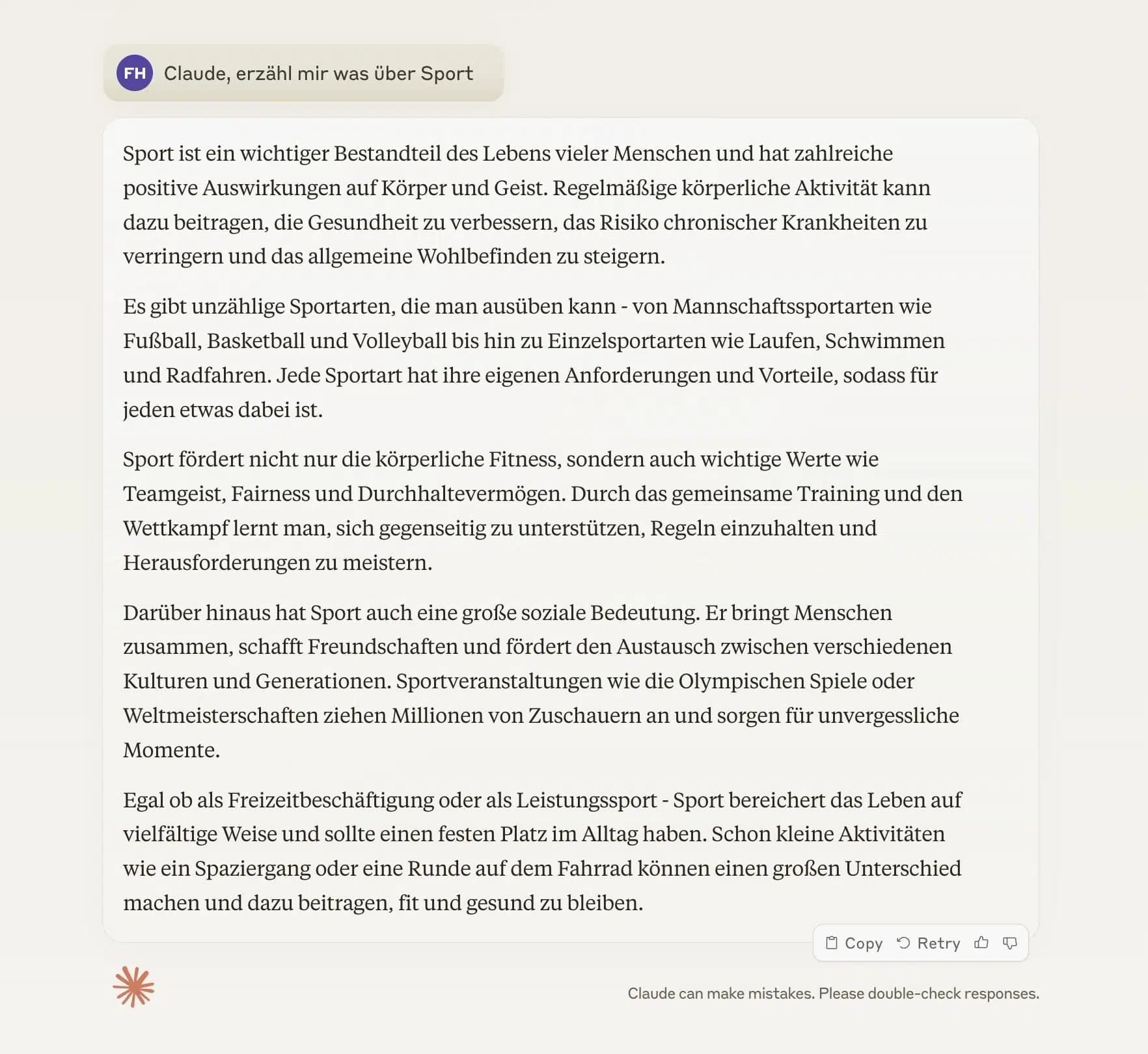
Instead, write something like:
Create a comprehensive and detailed essay about the history of sports. Cover the different types of sports, famous competitions, and the importance of sports for health and society. Use subheadings and lists to structure the essay.2. Break Complex Tasks into Clear Steps
If you want to give Claude a more complex task, you need to break down exactly which steps are necessary.
First, this ensures that the answer matches exactly what you expect. Second, it significantly increases the probability that Claude won't skip any task steps.
It's best to list the individual steps clearly structured as a list (numbered or with dashes):
I want you to create a poem interpretation for me. The following four steps are necessary:

- Step 1: Summarize the content of the poem for me
- Step 2: Describe the structure of the poem (verses, stanzas, rhyme scheme, meter, and end syllables)
- Step 3: Analyze the language of the poem
- Step 4: Interpret the poem

This is the poem to be interpreted:

[Insert poem]
The clear division into steps 1 through 4 in the example ensures that Claude executes the four tasks in the correct order and doesn't skip any steps.
3. Give Claude Examples
To clarify to Claude exactly what you expect from it, give it at least one or, better yet, several examples.
This technique is also called "one-shot prompting" (with one example) or "few-shot prompting" (with multiple examples).
Examples serve as templates and show Claude the direction of your request. Through examples, you make your prompts even clearer and more unambiguous.
Let's say you want to write a short story in which a child has an extraordinary superpower. Then you could give Claude the following prompt:
Write a short story about a boy with an unusual superpower.

For example, the boy could read thoughts through touch or talk to animals. The superpower should be both a curse and a blessing.

Tell about an event where the superpower plays a decisive role and triggers the boy to keep his powers secret in the future.
Through the concrete example, Claude has a reference for what kind of superpower you're imagining and that the story should highlight both positive and negative aspects.
Or, let's say you want Claude to come up with mythical creatures for a fantasy novel:
I want to write a fantasy novel featuring various mythical creatures living in an enchanted forest. Come up with a special and extraordinary mythical creature. Describe exactly its appearance, abilities, and behaviors.

Example:

Trihorn

A Trihorn is a graceful horse with three spiral horns on its forehead. Its coat shimmers pearl white in the moonlight. It is said to have magical powers: a liquid flows from its horn that can heal any wound. Trihorns are considered gentle and shy creatures. They rarely show themselves and flee with playful ease when in danger. Their hooves seem to barely touch the ground.
4. Have Claude Take on a Role
To get better answers from Claude (and other LLMs), you can have it take on a specific role.
This simply means telling Claude it's an expert in a certain field, for example.
Alternatively, you can have Claude take on the role of a real living or historical person, such as Steve Jobs or Albert Einstein.
This has two key advantages:
- Improved accuracy and performance: Especially in certain complex situations, such as solving complicated math problems or writing code, assigning a relevant role to Claude can significantly improve its performance and understanding of the task at hand.
- Adjusted tone and style: By specifying a role, you can influence Claude's tone, demeanor, and communication style to match the context. For example, asking Claude to act as a kindergarten teacher results in a very different response than asking it to act as a college professor.
Let's say you want to write a blog article about healthy eating. Then you could give Claude the following command:
You are a professional nutritionist with 30 years of experience. Write a comprehensive blog article about how to change your diet step by step to live longer. The article should be both scientifically sound and motivating and easy to understand. Address the reader informally.5. Use XML Tags
Another useful feature that Claude masters is XML tags. With these special commands within your prompt, you can specifically influence Claude's output.
You instruct it to mark, format, or provide additional information for certain parts of its response.
Let's say you want to hear Claude's opinion on a controversial topic but also get counterarguments and facts. Then you could use this prompt:
<opinion>What are the arguments for and against the introduction of a universal basic income in your opinion?</opinion>
<counterarguments>What arguments could critics of a universal basic income raise?</counterarguments>
<facts>Which scientific studies or experiments provide meaningful data on the effects of a universal basic income? Name 2-3 examples with sources.</facts>
The XML tags in this prompt ensure that Claude structures its response clearly and provides the requested information in an organized manner.
Another example: Let's say you need a list with headings and brief explanations of various concepts. With XML tags, you can specify exactly how Claude should design the individual list elements:
Create a list of 5 ideas for environmentally friendly means of transportation of the future. Use the following XML format: <item> <transportation>Name of the means of transportation</transportation> <description>A brief description of how it works and its benefits in 1-2 sentences.</description> </item>
Through the XML specification, Claude will generate a uniformly structured list that you can easily transfer to your presentation or website.
XML tags give you precise control over how Claude structures its output. You define what goes where, and Claude follows. Try a few different tag setups and see what works best for your use case.
6. Chain Multiple Prompts
Sometimes a single prompt isn't enough to handle more complex tasks.
This is where the "prompt chaining" strategy comes into play.
You divide your overarching goal into several intermediate steps and have Claude work on these subtasks one after another.
Let's say you want to create a social media post about the benefits of meditation - including a matching image, headline, and hashtags.
With a chain of multiple prompts, you could proceed as follows:
Prompt 1: Menu 5 scientifically proven positive effects of regular meditation. Summarize each effect in 1-2 concise sentences.

Prompt 2: Choose the 3 benefits from your list that you think sound most motivating for beginners. Formulate an appealing social media post to inspire people to meditate. The length should be about 200 words.

Prompt 3: Suggest 3 suitable headlines for the social media post you just created. The headlines should spark curiosity and encourage reading.

Prompt 4: Which 5 hashtags would you recommend for the meditation post to reach as many interested people as possible? Consider popular hashtags about meditation, mindfulness, and mental health.

Prompt 5: Describe a meaningful image that could visually support the meditation post. Address both motifs as well as mood and color scheme so that the image fits well into the feed and generates attention.
7. Let Claude Think
Claude is a real super brain and loves solving tricky tasks. So push it further by explicitly asking it to think.
With special "thinking commands," you can encourage Claude to engage deeply with a topic, weigh arguments, or develop creative solutions.
Let's say you want to write a balanced article about the pros and cons of homework. Then you could get Claude thinking with this prompt:
Think thoroughly about the pros and cons of homework. First, list all the arguments that speak in favor of homework from the perspective of students, parents, and teachers. What positive effects can homework have on learning success and personal development?

Then critically examine the downsides of homework. What disadvantages and burdens do they bring for students and families? Are there alternatives that offer similar benefits without the disadvantages?

Finally, carefully weigh both sides against each other. Consider different perspectives and individual situations of students. What overall conclusion do you come to? Formulate your recommendation in 3-4 concluding sentences.
By asking Claude to think intensively and weigh options, you get a thoughtful, multi-perspective answer that illuminates all relevant aspects.
Even with creative tasks, an explicit thinking pause can work wonders for Claude. Imagine you're looking for an unusual birthday gift for a cooking-enthusiast friend. With this prompt, you activate Claude's creativity:
Come up with 10 extraordinary gift ideas for a passionate home cook who likes to experiment in the kitchen and try new techniques. Also think of unusual kitchen gadgets, exotic ingredients, inspiring cookbooks, or creative cooking experiences. Be inventive and think "outside the box"!

Now look at your list and choose the 3 ideas that you think guarantee the wow factor and aren't immediately obvious as typical gifts. Which ideas would your cooking-enthusiast friend be most excited about?

Finally, describe how you would originally package or present the top 3 gift ideas to perfectly stage the surprise moment.
8. Give Claude a Starting Point
Sometimes you already know roughly what direction Claude's answer should go or how it could begin. In such cases, it makes sense to provide the beginning of the answer yourself. By dictating the start to Claude, you save valuable tokens and steer it directly onto the desired path.
Let's say you want to write a social media post about the benefits of your product. Then you could give Claude this instruction:
Create a social media post about the advantages of my new fitness program. Start the post with the following two sentences and then finish it:

"You finally want to get fit but don't know where to start? Then my new fitness program is exactly right for you!"
By putting the beginning in Claude's mouth, you set the appropriate tone, clarify the goal of the post, and save yourself and Claude valuable time in brainstorming.
The same works for texts where you want to particularly highlight a certain argument. Let's say you're writing an article about the importance of sleep for health. With this instruction, you specifically direct the focus to the mental benefits:
Write an informative blog article about the positive effects of adequate sleep on our health. Especially highlight the effects on our psyche and mental performance. Start the article with the following paragraph:

"We all know how refreshing a full night's sleep feels. But sleep is far more than just rest - it's a true booster for our mental health and well-being. Regular, adequate sleep can demonstrably..."
With this predetermined introduction, Claude can only go in one direction and is guaranteed to put the mental benefits in the spotlight.
Or let's say you want to write a compelling product description for your new sustainable garment, then your prompt could look like this:
Formulate an appealing product description for my new bamboo t-shirt. Start with the following sentence and then add information about material, production, fit, and wearing comfort:

"Our bamboo t-shirts are the perfect choice for anyone who values sustainability and comfort in their clothing."
Just like that, you've outlined the core message of the description and ensured that Claude picks up all other relevant points.
9. Define the Response Format Precisely
The formatting of Claude's responses is at least as important as the content itself. Well-structured, clear texts are much more pleasant to read and use, after all. With a few targeted instructions, you can control what format Claude presents its results in and tailor them to exactly the format you want.
Let's say you need step-by-step instructions for a recipe. Then you could give Claude these specifications:
Write detailed instructions for how to prepare vegan pancakes. Divide the recipe into the sections "Ingredients" and "Preparation." Under "Ingredients," list all required foods with quantities. Then describe under "Preparation" in numbered steps what to do. Visually highlight the individual preparation steps by indenting them and providing bullet points.Or let's say you want to write a promotional newsletter. Then you could give Claude the following prompt:
Design a newsletter that informs our customers about the latest discount promotions. Make the newsletter appealing and varied with the following elements:

- Use a personal salutation at the beginning.
- Highlight the discount amount and promotion period in bold.
- Divide the newsletter into several short, concise sections with meaningful subheadings.
- Set important keywords and calls to action in italics.
- Close with a motivating sentence and the greeting "Your Name"
This of course also works for blog articles:
Write a blog article about the benefits of traveling. Structure the text with a short introduction, followed by 5 numbered main arguments. Dedicate a separate paragraph to each argument and develop it in 4-5 sentences. Insert blank lines between paragraphs as visual separation. Close the post with a concise conclusion and a motivating call to action.10. Ask Claude for Revisions
Perfection often only comes through revision. This also applies to working with Claude:
Even if its first answer is already good, it can become even better through targeted "fine-tuning." So don't hesitate to ask Claude for a revision and give it specific suggestions for improvement.
Let's say Claude has created an advertising text for you. You already quite like the text, but you'd like a few more changes. Then you could ask this follow-up:
Please revise the advertising text once more:
- Emphasize even more the unique selling point of my product compared to the competition.
- Delete the technical details in paragraph 2, they're too complicated for the target audience.
- Add a punchy call to action at the end. Would you be so kind as to revise the text accordingly? Thank you!
When you need a complex text on a sensitive topic, a feedback loop can also be helpful. Let's say Claude has drafted a statement against discrimination. Then you could ask for this fine-tuning:
Thank you for the strong statement! I'd like optimization in two places:
- The tone is a bit too confrontational in places. Could you rephrase the sentences more friendly and factual without weakening the core message?
- Please write the last paragraph with the outlook a bit more extensively. What specific measures and positive effects could there be? It would be great if you could consider these points in the revision. Thanks!
Even for creative tasks, multiple feedback iterations are often the key to success. Maybe Claude wrote an entertaining short story at your request. You have a few more ideas for optimization:
Wow, what a funny story, thanks! I have a few more wishes to make the story more rounded:
- Please add more dialogue scenes to make the characters feel more alive.
- Add an unexpected twist in the middle to increase the tension.
- Describe the setting a bit more extensively so you can picture everything visually. Looking forward to the revision!
11. Use Claude's Maximum Context Capacity
Claude can remember an incredible 200,000 tokens (with extended context, up to 1,000,000 tokens). That's about 150,000 to 750,000 English words.
You should definitely take advantage of this enormous context length when working with Claude.
Let's say you're researching for a paper and want Claude to create a comprehensive outline. Then you could simply give it all the information collected so far and ask for a structure:
Here are my collected notes and quotes on the topic "Development of Artificial Intelligence in the 21st Century":
[... here you insert all your material so far ...]
Please read the information carefully. Then create a sensible outline for my paper based on the notes. The outline should include 4-5 main chapters, each divided into 3-4 subchapters. Assign meaningful headings that briefly summarize the content of the chapters.
Or imagine you're working on a complex software project. Then it would be extremely practical to show Claude your entire code so far and ask about the best solution for a problem:
Below you see my current codebase for the development of the Android app:
[... here you insert your complete code ...]
Currently I still have a problem with the implementation of the login function. The validation of user data isn't working correctly yet. Please analyze the relevant code, explain what the error could be, and suggest a concrete solution. Explain your thought process step by step so I can follow your reasoning.
The same applies to creative writing projects: If you're planning a novel, just let Claude dive into your entire worldbuilding. Show it all your notes about plot, setting, and characters and then ask for more ideas:
These are my thoughts so far for my fantasy novel:
[... here you insert all your material, including descriptions of the world, characters, rough plot, individual scenes, etc. ...]
Please read everything at your leisure. Based on this information, do you have any other ideas for how I could add tension and depth to the story? What new twists, conflicts, or character developments come to mind? Let your creativity run free and give me 5-10 concrete suggestions for how I could develop the story further.
12. Use a Helper Meta-Prompt
One of the most powerful tools when working with Claude is meta-prompts. You give Claude a helper prompt once that influences its general way of working. This meta-instruction then applies to all following prompts without you having to repeat it every time. This way you can tune Claude to your individual needs and preferences in no time.
Imagine you're working on a longer writing project. To keep track at all times, it would be practical if Claude automatically created a brief summary of its results. Then you could send this helper meta-prompt ahead:
Here's a helper meta-prompt for you, Claude. Please observe it for all my following prompts:
@ the end of your answer, always summarize the key points in 2-3 brief, precise sentences. Mark this summary as "Summary:" so I can recognize it at first glance. This instruction applies until I revoke the helper meta-prompt.
From now on, Claude will automatically preface all its detailed answers with a brief essence - super practical for quick orientation!
The possibilities for helper meta-prompts are virtually endless. For example, you could ask Claude for particularly simple, understandable language in general:
Here's a helper meta-prompt for you. Please apply it to all further prompts until I say otherwise:
Write all answers in particularly clear and simple language. Avoid foreign words and technical terms and explain facts as vividly as possible. Your texts should also be understandable for people who are not experts in the respective topic.
With this meta-prompt, you're guaranteed to always get easily understandable explanations from Claude - perfect when you're researching complex topics.
Meta-prompts are also extremely useful for creative tasks. Maybe you want to write a story in the style of a particular author? Then prime Claude with this meta-prompt:
This is a helper meta-prompt for you. Please follow it for all my further prompts until I let you know:
Imagine you are the world-famous author Stephen King. Write all following texts in his unmistakable style: dark, suspenseful, and visually powerful. Include many eerie details and unexpected twists. Use his typical stylistic devices, such as vivid metaphors or terrifying cliffhangers.